The privilege of questioning - Papa De (DeLovie Kwagala) in Conversation with Nanoah Struik
The privilege of questioning - Papa De (DeLovie Kwagala) in Conversation with Nanoah Struik
September 9, 2026 — Papa De
For this interview, Papa De spoke with Nanoah Struik (they/them), a Dutch-Nigerian writer, speaker, queer activist and award-winning podcast maker. Across their work, Struik engages with queerness, gender identity and diversity, gender equality, and the possibilities of challenging binary systems.
Nanoah Struik: In your residency you’ve worked on a new project. Where does a new body of work usually start for you: with an image you can already see in your head, a material you want to touch, or a question you can't stop asking?
Papa De: It usually starts with an idea, then I visualise what I want the idea to look like, then see how that idea gets reinterpreted through the reality of making it. But with the residency, I actually had no idea what would come out. A lot of it was intuitive. I already had the archival images from my family, but no idea how I wanted to present them, and that kept shifting throughout the month. That's the beauty of a residency: you have space to give it your all, to play with what works and what doesn't, until you land somewhere you're happy with.
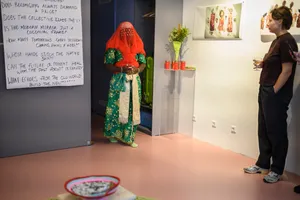
Normally I work with imagery, I photograph other people. This time was different: I didn’t have that at all. It had to be introspective: I have these images, what do they mean for me? What's my position in telling these stories? There's a difference when the images aren't ones I made myself because my only connection to them was that they came from my grandmother, my curiosity about the dress's [gomesi] history, and the culture itself. Which is also where there's a disconnect: it's a culture that invalidates me, that tells me I don't fit the mold of what it means to be a Ugandan not-woman, nor man.
NS: As you said, you usually are the one behind the camera, photographing dozens of other people's faces and stories in Uganda's queer community, but in your new work ME(MORIES) you insert your own body into a family archive that predates you. What is it like to become the archive yourself?
PD: Honestly, the process was bittersweet. In the days before the opening, there was a cover image of a woman in the dress [gomesi] on a screen outside the residency door. I would see it every time I would pass by it, but at some point I didn't want to see it anymore. It hit me: I'm here representing a culture that doesn't give a fuck about me. But also: most of these women have never even left the country, and somehow they end up on a screen in Amsterdam, in this very cultural attire. Amsterdam of all places: I learned that a lot of the fabric for these dresses are printed and distributed in the Netherlands. It made me question my positionality in this narrative.
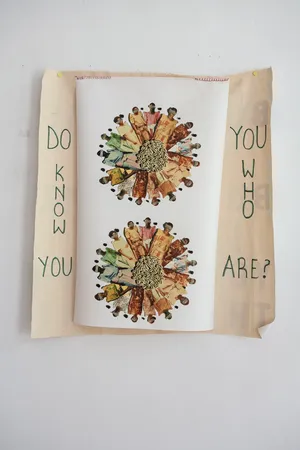
But it was also a rebellion: inserting myself into the archive: you cannot erase me. I'm as much part of this culture and tradition as anyone. My queerness, and being neither woman nor man, doesn't take that away. It's not meant to alienate me from culture or tradition. At the same time, I didn't want to impose myself too much. So I masked their likenesses, respecting that their journey was different from mine, while still honoring that my history, as a queer person, is erased, and I find a way to write myself into the story anyway.
NS: You’ve worked across street photography, staged portraiture, and now archival collage and installation. How do you know which form a story needs to take: when does something want to be a photograph, and when does it want to become an object?
PD: Myself, I’m a constant becoming so I also don’t want to limit any shapes or forms that might want to reveal themselves through the process. The residency work kept evolving, which let me stop controlling it and just be intuitive. It was the first time I mixed disciplines. My first solo show in Berlin was the catalyst, indirectly: that's where I first used sculpture. I felt: there's more to explore there.
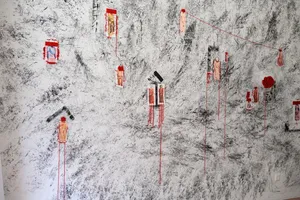
During the residency I really pushed outside my comfort zone. I was a blank canvas, and I let the work paint on me.
NS: Belonging, memory and the body under scrutiny return again and again in your work. Are you circling the same questions from new angles each time, or does each project change what you believe about them?
PD: I keep going back to the same questions and getting different answers from myself each time: we're not the same people we were yesterday, and as the world shifts, systemically and economically, what these topics mean shifts too. Even in interpersonal relationships I've been told I repeat the same questions over and over again. Not because I expect a different outcome, I just believe in the art of inquiry and how time influences responses. That's how my brain works as a neurodivergent person, and that flows into how my work works too.
NS: Next to being an archivist and a storyteller, you’re also an artivist. Activism often wants to be understood quickly and clearly, yet art often resists that. How do you navigate the tension between wanting a message to land and wanting a piece to stay open to interpretation?
PD: However articulate you think you are, however much you believe something is true, perspective shifts things. I’ve learned to be less rigid about what I believe, to make room for other people’s perspectives. Different perspectives can be at the same time. There's room for nuance without erasing the other. That's also how you don't take away someone's free will: you let people examine things themselves, especially on topics they may never have thought about.
NS: In a conversation with an archivist, I think we’re quick to look back. But what’s something you’re only just beginning to look forward to, artistically?
PD: The freedom to question and the privilege of being in a space where you can. To be able to just sit with things and have different outlooks, instead of just accepting what you've been told. Our forefathers never really questioned things the way we do now. Your great-great-grandmother followed the same script: nothing to question. Growing up in African tradition, you're told you can't do something, or you must do something, and you’re not allowed to ask questions. But here I am: questioning. We are the generation of asking why. And as a parent myself, I want my son to be able to question too.
Photos Credit: Iliana Michali

Isaac Titsinghkade 6A-B
1018 CA Amsterdam
The Netherlands
Isaac Titsinghkade 6A-B
1018 CA Amsterdam
The Netherlands
© 2026 FUTURES Foundation
© 2026 FUTURES Foundation