
PHotoESPAÑA

Member from 2018 until 2024. Located in Madrid, Spain, Spain

PHotoESPAÑA

Member from 2018 until 2024.Located in Madrid, Spain, Spain

PHotoESPAÑA was born in June 1998 with the aim of being a photography festival carried out by society. Promoted by the Contemporary Foundation and organized by La Fábrica, PHotoESPAÑA makes Madrid and Spain become each year a meeting point for the world of Photography. A festival designed and made in Spain, which has become an international reference thanks to the work and involvement of specialists and agents from the artistic, cultural, and political fields, the collaboration of institutions and the participation of the public. The Festival has always had an international vision, directing its gaze to large artistic territories: Europe, North America, Latin America, the Far East, etc. However, Spanish photography has always had a relevant role in PHotoESPAÑA, whose intention is to present a panorama that accounts for its richness, energy and plurality. The seventeenth edition, in 2014, was entirely dedicated to the evolution of Spanish photography from the XIX century to the present, highlighting the work of young creators who are contributing new ways of looking at photography and who enjoy an important international echo. One of the most personal characteristics of the Festival is the choice of a general commissioner who is in charge of programming for three consecutive years. Three years are enough to develop theories and concepts around the photographic fact.

Nominations

2023

Similarly, the five contemporary photographers PHotoESPAÑA is nominating for FUTURES this year are developing work that stands out on today’s scene, offering five different yet complementary perspectives that provide an overview of contemporary practices, ranging from documentary (Umberto Diecinove) to a type of expanded photography that incorporates performance (Monica Egido), to work with the photobook format (Irene Zottola) and conceptual photography (Laura San Segundo and Rita Puig-Serra Costa). In 2022, PHotoESPAÑA closely tracked these artists’ progress.

‍

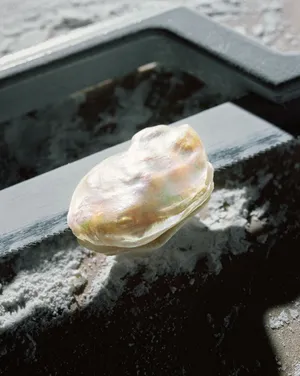
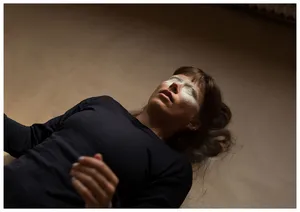
In her project Ícaro, published as a photo book in 2022, Irene Zottola uses photography to offer a mystical fable as a metaphor of the contemporary world. In FOMO, also from 2022, Mónica Egido uses a performative duel to represent the need to stop and observe ourselves silently for an extended period of time. In The Circular Enclosure, a project currently underway and started in 2023, Laura San Segundo resolves a succession of landscapes as mental sites where the dialogue takes place between photography and the subconscious and is capable of transcending the inherent meaning of an image or element. In Anatomy of an Oyster, started in 2018 and still underway, Rita Puig-Serra Costa uses the photographic image to formulate a first-person journey into the past, in an attempt to tell a story of violence and abuse silenced by time. Finally, in the ongoing project INSCTS, Umberto Dicienove sets out to document the potential change we can achieve with insects, providing a global view with a special focus on people working on this change and those who will benefit from it.

‍

Mónica Egido and Umberto Diecinove developed their projects as part of our MA in photography and artistic projects – the festival’s training programme. Laura San Segundo and Rita Puig-Serra Costa stood out within the set of projects submitted to the Discoveries viewing programme. And the Irene Zóttola’s photobook Ícaro was chosen for the 2022 PHotoESPAÑA award for Best Photography Book of the Year.
2022

Ignacio Navas draws from everyday life to explore the political, social and personal structures that comprise us. His project is a critique on the capitalist system, and theinstances of micro-violence that define it.

‍

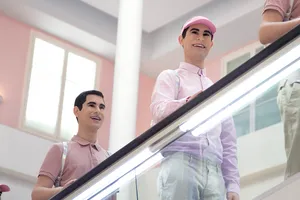
With her Paul project, Cristina Galán suggests the subversion of identity and something sinister under the visually-polished surfaces of reality. Figures suspended intime appear in an idealised but impersonal world, representing the clichéd spaces of consumer society.

‍

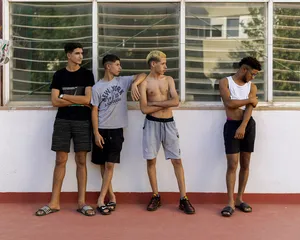
A disturbing feeling also permeates Felipe Romero Beltrán’s Dialect project, which saw the artist recreate the everyday lives of a group of Moroccan youngsters, as they await a future beyond an immigrant centre in Seville.

‍

In Como la casa mía Laura C. Vela accompanies Xirou, a Chinese immigrant woman, in her search for a way of being in the world. The work is both an exploration of the main character’s inner world and a significant photographic encounter between two women.

‍

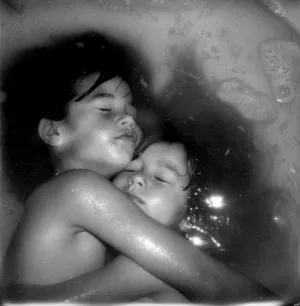
Finally, Lorena Morin reflects on family life through intimate images of her partner, herself and their children. Captured in shared domestic spaces, her photographic diary reflects 15 years of familial love and unbreakable bonds.

2021

The artists selected by PHotoESPAÑA in this edition are: Marius Scarlat (Romania, 1993), Antonio Guerra (Zamora, 1983), Suwon Lee (Caracas, 1977), Carlos Alba (Madrid, 1984) and Arguiñe Escandón (Bilbao, 1979). The possibility of seeing their work together offers us a contemporary vision of photography in Spain, in which proposals that are more documentary in nature are displayed side by side with works that are more conceptual, with the use of photography that intersects with installation. In the midst of the digital age, the pandemic has intensified the need to think about our immediate environment and our social relationships.

‍

In this context, the work of the authors selected offers us a space for reflection and confrontation about issues relating to globalisation, technology and the environment. Marius Ionus Scarlat works on issues of Romanian identity from a personal perspective marked by his family’s migration to Spain. Suwon Lee also does it from a gender perspective and through her own body in light-based performative actions. Antonio Guerra investigates the construction of contemporary landscape its transformation processes and our perception of it through image, in a work that merges photography and sculpture.

‍

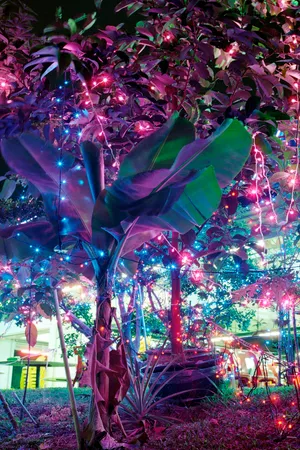
Technology is also present in the artworks of Carlos Alba who addresses issues relating to everyday life in a world in continuous transformation. The specific project he presents is on light pollution in large contemporary cities. Contemporary nightscapes of great beauty that hide devastating effects on the population and the environment. Finally, night light is also the object of study along with sound in the project presented by Arguiñe Escandón, through which she has investigated theparanormal effects occurring in an area of the Spanish Mediterranean produced by a magnetism that alters the life of the inhabitants, the fauna and the flora.

‍

The five authors are at a crucial moment in their careers. In the past year, their work has been critically acclaimed and they boast international experience they can expand thanks to the Futures platform.