

Oikeiôsis
Mara Palena
Oikeiôsis
Nominated by CAMERA Centro Italiano per la Fotografia, 2022
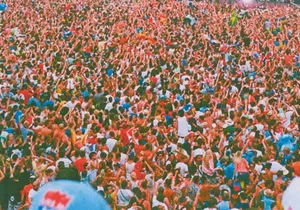
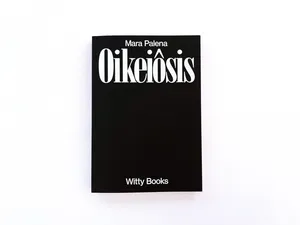
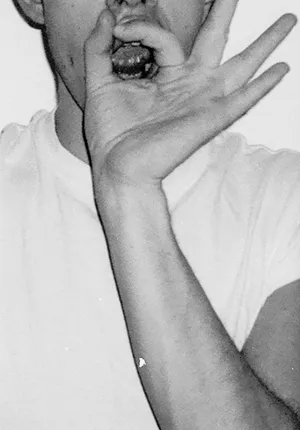
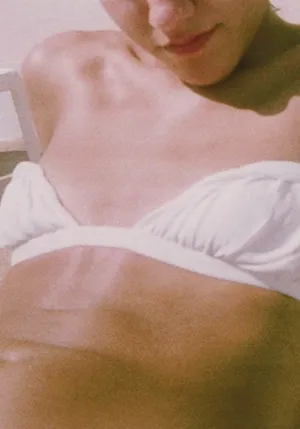
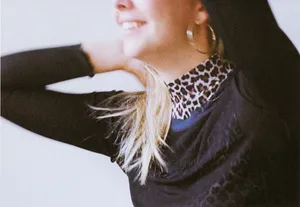
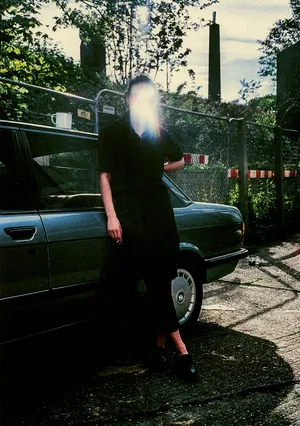
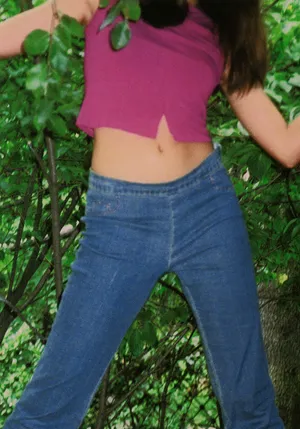
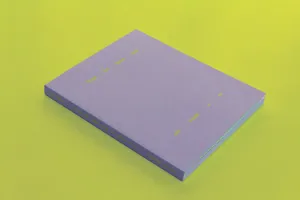
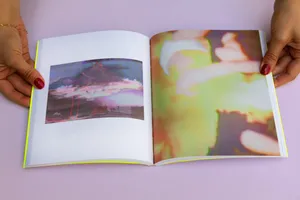
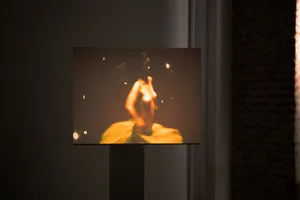
The notion of memory is only one of the motives that pushed Mara Palena to start a long process - potentially infinite - titled of "Oikeiôsis". An ancient Greek word, used to indicate self-realization through the knowledge of the inner self. Using analog archival pictures, produced from the artist's childhood up until today, the process is a continuous image alteration that seems to be regulated by a state of consciousness that is at times fragile and melancholy, sometimes romantic, sometimes sharp - almost violent - but never graspable. Alterations similar to a sound frequency, which regulate the tone of our perception of reality and its aesthetic transposition; universal frequencies that vibrate in the presence of a memory, which permeates every body. Passing through the crowd of a rave, where human profiles can hardly be recognized, the audience find himself in a large cardiac apparatus, which pulsates through the images and sounds of a diary. A memory that not belong to the viewer, but seems warmly familiar. Oikeiôsis is a term introduced by the Stoic philosophers (ca. 300 BC) to indicate the realization, the ultimate goal of living beings. According to the Stoics it is the knowledge of the self, through the synaesthesis, or internal perception. Thanks to this self-knowledge living beings can fly, swim, move without anyone ever having taught them. It contains therefore the strength, health, beauty, functionality of the body, as well as love for one's own species and in man for his community. The full work is a mixed media work where the artist, experimenting the sound therapy, develops with a sound designer, Donato Panaccio, frequencies linked to emotions and feelings trying to reach a deeper understanding of the inner self-awareness. Matilde Scaramellini, Twenty14
Things that happen inside and outside of me
Mara Palena
Things that happen inside and outside of me
Nominated by CAMERA Centro Italiano per la Fotografia, 2022
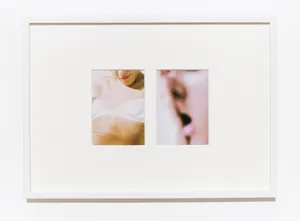
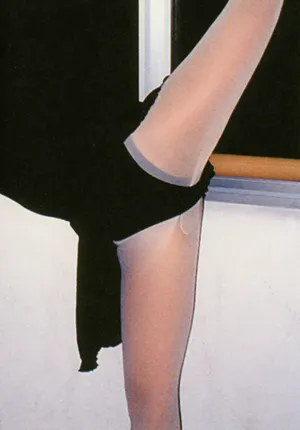
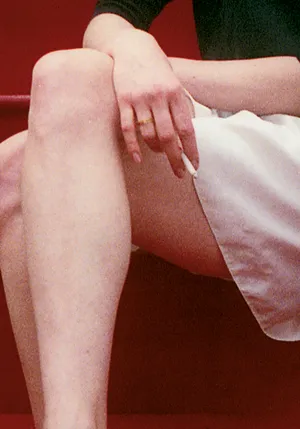
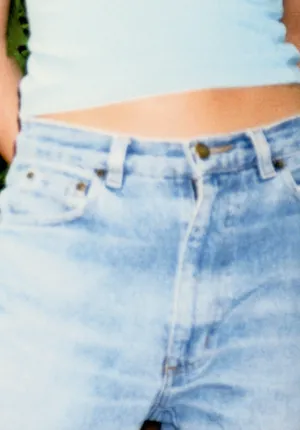
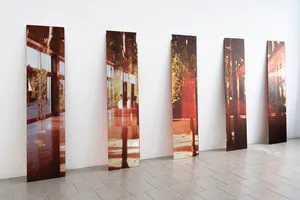
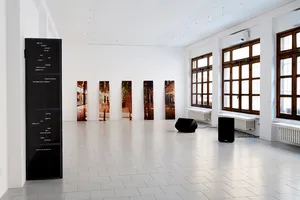
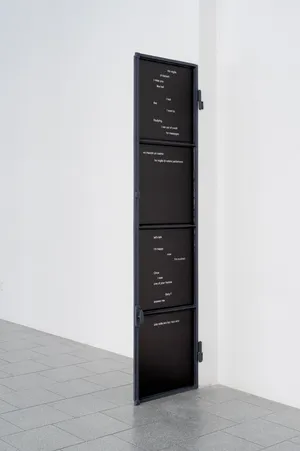
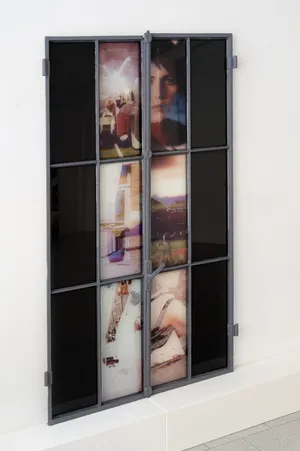
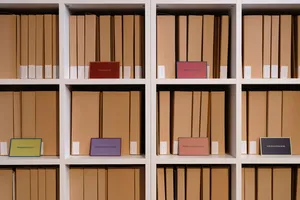
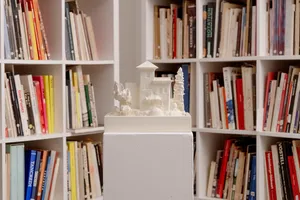
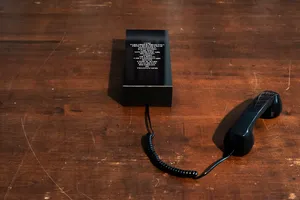
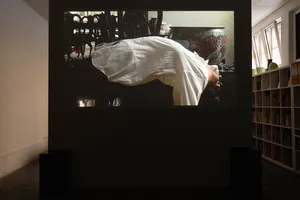
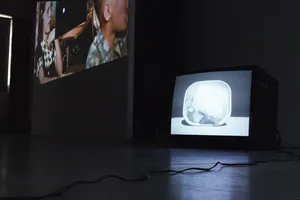
Fondazione Galleria Milano presents Things that happen inside and outside of me, a solo exhibition by Mara Palena curated by Laura Lamonea, accompanied by an introductory text by Lamonea. The project, developed in close collaboration with the Foundation, offers a multidisciplinary exploration in which various forms of expression interact with the architecture of the exhibition space, creating a profound relationship between the physical space and visual exploration. Mara Palena’s work navigates the realms of the conscious and the unconscious, the present and memory, reworking existential fragments through methods of self-exploration that range from psychoanalysis to sound therapy and EMDR. Her research transforms the intimate sphere into a collective experience, inviting the observer into a potentially infinite mnemonic archive, giving rise to projections that vanish and are reborn incessantly. Things that happen inside and outside of me transports the viewer to an intimate and personal place, that is amplified, light, tragic and rich with possibilities, just as adolescence is: “a gateway, a narrative that Palena ceaselessly rewrites and formalizes through images, sound, and writing […]. Adolescence is a persistent state of mind and a way of being in the world in which every experience is amplified and repeated” Laura Lamonea. Most of the works were created specifically for the 2026 exhibition. On the first floor, in the main hall, the 1960s iron-windows display prints of screenshots taken from videos in the Prelinger Archives in San Francisco, reworked using artificial intelligence—a meeting and clash between private memory and the collective unconscious (Goodbye Fear Dreams)—and texts excerpted from personal writings (Una volta ero tra i tuoi eroi). The same room features the installation Casa degli Specchi: salvaged massive mirrors, marked by deterioration, whose imperfect material renders the memory frayed and thus universal, accompanied by an audio track with sound distortions curated by Donato Panaccio (Vanishing Loud). The floor is completed by an imperfect and vulnerable sculptural model (Home/Home/Home), inspired by the family home on Elba, Villa Poliz. Things that happen inside and outside of me, Fondazione Galleria Milano, curated by Laura Lamonea Ph Celine Alma On the lower level, in the archive’s space, the video “Reprojected Movement” (2024), filmed at Villa Poliz, depicts everyday actions from the artist’s adolescence reenacted in the present: an encounter between the adult woman and the past in which her personality was formed. The final work is a telephone placed among the shelves of the Foundation’s library, an intimate and historic space, through which Mara, now an adult woman, reads passages from her teenage diary (Noia, mare, che ci posso fare?, 2026). The entire exhibition is built on continuous references: “memories almost never emerge as isolated units; they call upon one another according to associative logic” (Laura Lamonea). The Things that happen inside and outside of me is organized in collaboration with the De Pietri Artphilein Foundation in Lugano.
DRINK THE ROSE, SPIT THE DREAM
Mara Palena
DRINK THE ROSE, SPIT THE DREAM
Nominated by CAMERA Centro Italiano per la Fotografia, 2022
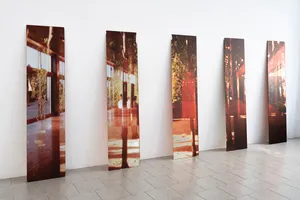
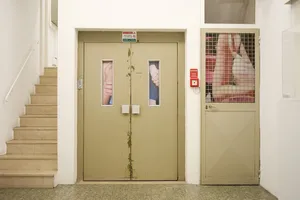
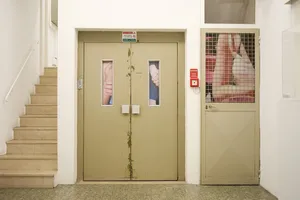
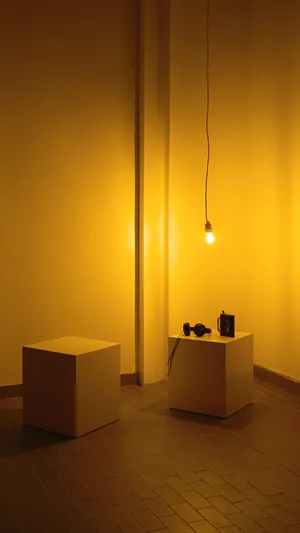
Figura (figure) is an Italian word of Latin derivation that shares the very same etymology with fingere (to pretend), which used to mean to mould, originally. Its primary meaning concerns the appearance of something, but it is also adopted in physics, geometry, and often art — as ‘Landscape with figures’ exemplifies. However, when it comes to Mara Palena’s work, the most immediate meaning that comes to my mind is to dance, as figure (figures) — and I thank Treccani’s accuracy — also stand for “a series of harmonious movements in time and space, either of a whole person or just one body part (e.g. arms, legs, torso, head, and so on). Each figure is governed by the laws of cadence, rhythm, and proportion, and bears a particular name.” Such harmonious movements are not to be seen here: you will only glimpse, behind opaque glass and grill-protected openings, a few gestures. Or rather, each of us will see different things by observing this choreography’s figures, where we are the actual dancers. We dance in space, we move to the sounds of the artist’s memory, trying to interpret the unknown, recognize words, identify sources. When there’s nothing to look at, you may see yourself. You may listen to the sound of the sea despite the city out there, feel your feet wetting, and hear the waves crashing on the rocks. What’s the difference between your body and those rocks? A seagull afar. I look at the ceiling and see a plane. Crickets chirp outside the window, yet it’s November in Milan. I always hear them as I cycle along the disused tram tracks; they hide amid the fallow grass, they hide in my hair. I move my hands messily to try to shoo a fly, push your voice away, push the memory of you away. One two three four five six seven. I’ve even searched for hypnotic techniques to try to sleep, to shut off my thoughts, as sorry as I am that you are alone and sad. Hearing you laugh comforts me, lifts me up, but that accordion is a bad omen, the even stronger misery of your loneliness. It’s the misery for the passing of time, of people, for that amazement, carefreeness, courage you only have in your teenage years. And if a straight line is an infinite set of aligned points, with neither beginning nor end, extending endlessly in both directions, having one dimension only, the length, always straight and with no thickness, then I know that, as I follow this choreography, I’d rather go astray. I’d rather go astray. M1arta Cereda
REPROJECTED MOVEMENT
Mara Palena
REPROJECTED MOVEMENT
Nominated by CAMERA Centro Italiano per la Fotografia, 2022
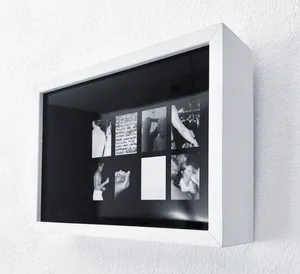
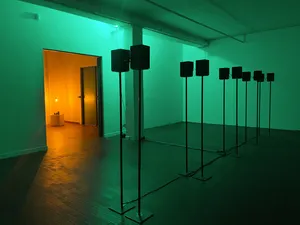
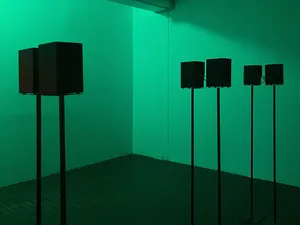
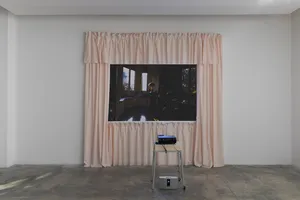
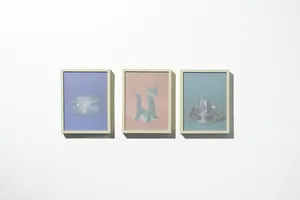
Galleria Studio G7 presents Project Room, a new initiative dedicated to emerging personalities in the contemporary art world, aimed at promoting and sharing new national and international artistic explorations. Mara Palena opens the project with The Window, a solo show curated by Laura Lamonea which features a new film interwoven with a series of previously unseen photographic artworks. The video was filmed in the artist’s childhood home, where she moves through the rooms, experimenting firsthand with the relationship between her adult female body and the domestic space in which she grew up. In this microcosm, charged with memory, daily actions blend with reconstructed and intimate gestures performed in front of the camera. The changing light marks the passage of time, interspersed with black-and-white images. The large window, doors, and objects, central elements of the narrative, are framed in compositions that evoke the stillness of photography. Here, time seems to slow down, trapped in the impossibility of fully capturing human experience. Yet, in her domestic walks and repeated gestures, a desire emerges to intervene, to grasp, to transform fleeting moments into material for understanding. Despite the apparent insignificance of human existence when measured against the vast scales of time and space, the artist focuses on a sequence of minimal, interconnected events. This interplay of small actions turns the everyday into a field of possibilities, where past and present converse, rewriting each other. The video’s soundtrack is taken from Automatic Popular Music, the 2023 musical project by Nicola Ratti, who mixed three tracks from the album specifically for this work. Structured around rhythmic and harmonic repetition, the compositions are built almost entirely from sounds generated by programmed modular synthesizer automatisms, punctuating the enigmatic score that Mara Palena constructs with her body and the surrounding space. The Window – G7 Ph: Francesco Rucci The Window – G7 Ph: Francesco Rucci ph Francesco Rucci The study of behavior and memory processes has been a core element of her research since its inception. Between 2018 and 2020, she created the trilogy A Study on Behaviour in collaboration with lead performer Jessamine-Bliss Bell. In this work as well, the temporality of the image plays a central role, becoming a perceptual material, even though everything unfolds within the span of a single day. The photographic series Reprojected Movement captures certain objects from the video, scanned from film footage and later preserved in boxes with opaque glass. Photography serves as a starting point in the artist’s practice, only to be manipulated and altered, playing with perception and memory. The selected objects, relics from a childhood living room, are stripped of context, function, or emotional associations that make them familiar or part of everyday life. Instead, they become pure form, opening up to new possibilities of meaning and relation. Laura Lamonea
IL TEMPO ENTRA ED ESCE ED IO CON LUI
Mara Palena
IL TEMPO ENTRA ED ESCE ED IO CON LUI
Nominated by CAMERA Centro Italiano per la Fotografia, 2022
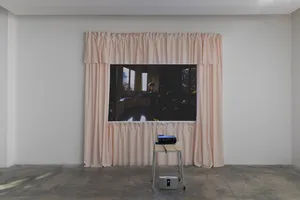
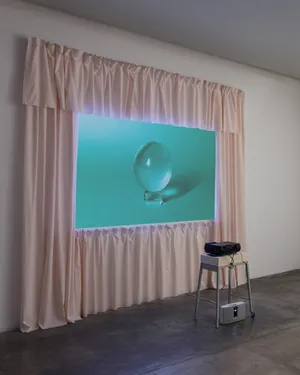
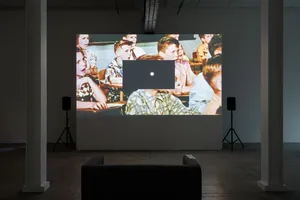
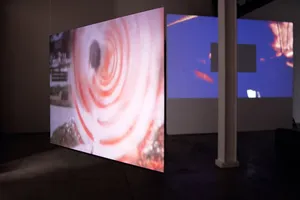
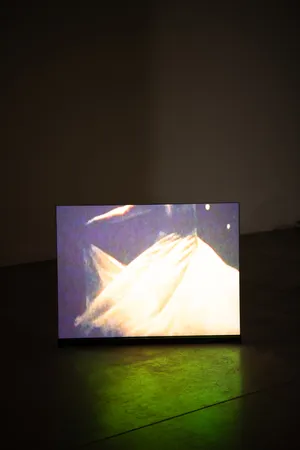
two exhibitions by Mara Palena curated by Marta Cereda and Matilde Scaramellini In this dual exhibition, Mara Palena ventures into the terrain of traumatic memory, bringing to light the deepest layers of the unconscious through video installations and photography. Here, time dissolves, and memory takes shape, creating an intimate dialogue between the individual and the collective. The exhibition project suggests a reconnection with one’s own history—a physical and conceptual passage that, in the artist’s work, becomes an experiential archive shared with the audience. A safe space where the weight and beauty of human existence resonate between sound frequencies and classical music notes. Il tempo entra ed esce ed io con lui is not only a figurative movement, as every piece in the Careof space is living memory: a Polaroid encased in ice, revealing a rose as it melts—a testament to fragile yet persistent resilience. Exposing the most intimate psychic mechanisms that emerged during EMDR (Eye Movement Desensitization and Reprocessing) therapy, the artist does not shy away from the traumatic events of her past. Instead, she guides the viewer through an exhibition that leaps across time and space, following perception before stepping back to observe it from a distance. In EMDR therapy, the concept of a safe place is crucial. It is used as a resource during treatment, an imaginary mental space co-created by the patient and therapist. This place serves as a tranquil, comforting, and threat-free environment where the patient can mentally retreat at any moment to find relief from stress or anxiety. In the spaces of Pananti Atelier, Palena constructs Posto al Sicuro in much the same way—a shared emotional refuge where the gallery walls do not merely contain the artworks but rather embrace and protect what the artist and the audience wish to hold onto, fear losing, or simply seek comfort in. Mara Palena’s entire artistic practice revolves around a reflection on human emotions in relation to time, memory, and identity. In her installations, she uses photography, sound, and video as a starting point, manipulating and altering them to explore themes of memory and individuality. An awareness of human fragility is a central, almost obsessive element in her research, which focuses on the study of emotional states. Conscious and unconscious, present, memory, and projection blur in the existential fragments that the artist layers within her projects. She draws from various methods of self-exploration, including psychoanalysis, sound therapy, and EMDR—practices she has personally experienced and later reinterpreted through her own unique artistic lens. Yet, this intimate sphere expands into the collective, constructing immersive scenarios that empathetically welcome the audience into a vast and potentially infinite mnemonic archive.
Mara Palena
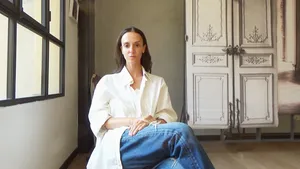
Mara Palena (1988) lives and works in Milan. Her research focuses on themes such as memory, recollection, and identity. She works with photography, video, and sound, reworking materials from archives, often open and participatory, like home movies, and drawing on a personal archive of photographic images that she has been curating for years to document her life. Her work has been exhibited at various international festivals, venues, and galleries, including the Guardian Art Center in Beijing, Galleria Studio G7 in Bologna, Careof, Marsèll Paradise, Nowhere Gallery, Pananti Atelier, and Video Sound Art in Milan, the Istituto Italiano di Cultura in Madrid, MOPLA in Los Angeles, Artphilein Foundation in Lugano, and Recontemporary in Turin. Between 2021 and 2024, she was a finalist in several art prizes, including the Lucie Foundation, Combat Prize, Premio Fabbri, New Post Photography, and Artphilein Photo Book Contest. In 2022, she was selected by Camera Torino for FUTURES Photography. Her work Oikeiôsis won the 2022 Surprize Award from Sprint and the Marcelo Burlon Foundation. The editorial project was curated and published by Witty Books in 2023 and was included by Photo España among the 100 best books published in 2024.
ProfessionPhotographer, Visual Artist, Writer, Art Director, Filmmaker, Researcher
IdentityWoman, White
LocationSouthern Europe, Italy
PracticePortrait, Archives, Conceptual, Mixed Media, Installation, Interactive, Video, Text, Multidisciplinary
TopicsPost-memory, Identity, Intimacy
CityMilan
Nominated byCAMERA Centro Italiano per la Fotografia
Year2022
Close

Address
Isaac Titsinghkade 6A-B
1018 CA Amsterdam
The Netherlands
Address
Isaac Titsinghkade 6A-B
1018 CA Amsterdam
The Netherlands
© 2026 FUTURES Foundation
© 2026 FUTURES Foundation
Close