The Ontologies of Space: Case Studies of Jeju - Jenny Smets in conversation with Michał Sita and Anna Pilawska-Sita
The Ontologies of Space: Case Studies of Jeju - Jenny Smets in conversation with Michał Sita and Anna Pilawska-Sita
November 27, 2025 — Jenny Smets
Including different perspectives and maintaining a collaborative, investigative attitude are essential aspects of the artistic practice of the Polish couple Michał Sita and Anna Pilawska-Sita. Unexpected, yet perhaps inevitable, their residency at the Future Hub concluded with a playful workshop inviting participants to rethink space from the perspective of a golf ball. It marked a momentary conclusion of their ongoing collaborative research — a process that continues to evolve and is centered on the South Korean island of Jeju.
Anna and Michał live in Poland with their son and dog. They each have independent practices, but sometimes they combine their distinct backgrounds to create collaborative work that blurs the boundaries between architecture, art, photography, and humanistic research.
Anna brings expertise in architecture and spatial design, having studied at the University of Art in Poland and worked extensively on exhibitions and landscape projects. Her special interests include green architecture and landscape forming. Michał is a photographer, curator, and anthropologist, focusing on social memory and imagined histories. Collaboration allows their analytical and spatial approaches to converge, producing outcomes richer than the sum of their parts.
Their first major project combining these interests was Cù Chi Tunnels, documenting a 250-kilometer network of military tunnels in Vietnam that were life-saving during the war with the United States and later restored, a project initiated by the Polish architect Kazimierz Kwiatkowski.
This project brought them to the attention of the 4th Biënnale of Jeju (2024), organized by the Jeju Museum of Art. The South Korean island of Jeju is scattered with post-colonial Japanese military structures, left by the Imperial Japanese army when controlling Jeju in the years 1910-1945. This heritage is largely neglected and impossible for residents to fully engage with. The Jeju Museum of Art invited artists, unconnected to the local context, in the hope that their fresh perspectives might uncover aspects of the heritage that locals could not see. Anna and Michal were invited for a two and half week stay.
Their work went beyond documentation, asking: how does post-colonial architecture retain its potential even as the landscape changes?
“What does it mean that they [the military structures] are still there, how would you imagine the whole island or the vicinity of those structures if you follow their logic? We wanted to see... do they have some kind of power to redefine what the space around them is?”
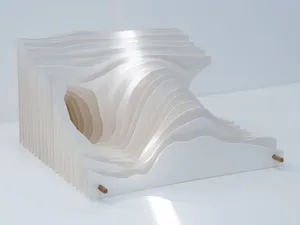
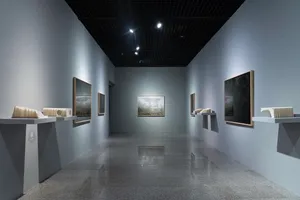
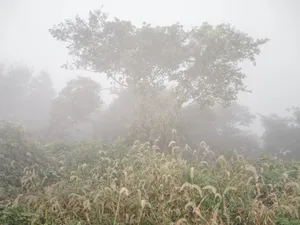
At the Biënnale, Anna presented models showing how fortifications merged with natural surroundings, while Michał displayed photographs of the dense forests concealing these structures. This first visit marked the beginning of an ongoing research project into the ontology of Jeju’s landscape. Returning in 2025 for a one-month residency, they spoke with local artists to gain insights into long-term projects and responses to landscape changes, such as tourism development, reforestation, and restoration efforts.
For their ontological survey, Anna and Michał turned to infrastructure shaped by tourism: golf courses.
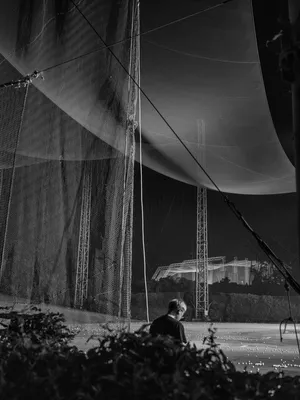
Golf courses reveal a unique relationship between visibility, artificiality, and human influence. Often hidden behind forests or hedges, carefully designed for players’ experience, these spaces exist in a constructed, imaginative world. The focus point for their study was a borderland between these spaces and real life, the tension between what is visible and what is deliberately concealed. The combination of natural terrain, structured nets, and hidden landscapes highlights aesthetic contrasts and the human capacity to reshape the environment.
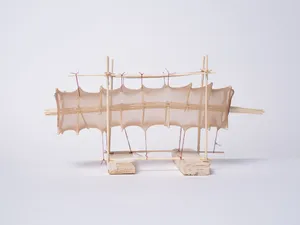
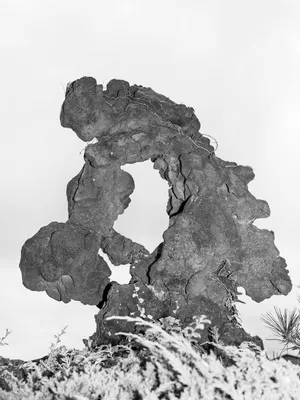
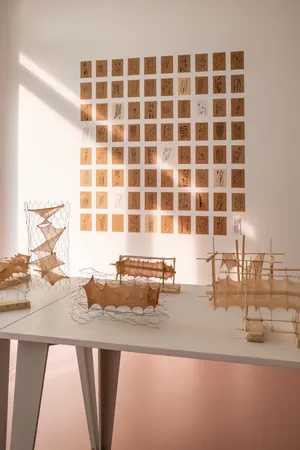
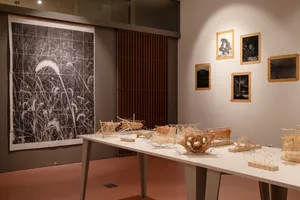
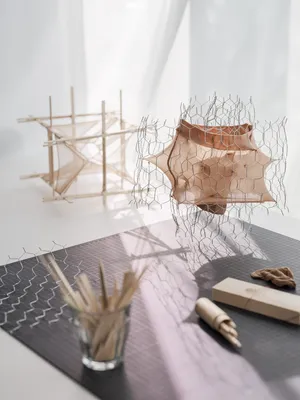
During their stay at the Futures residency, Michał and Anna organized the results of their research into visual work. At the open studio, Anna’s work was displayed on a long table, exploring how energy and tension applied to material from outside or inside can define a space. She visualized this through small constructions made of wood, chicken wire, and pieces of tights, which resembled miniature driving ranges. On the wall, drawn portraits of trees from Jeju and sketchy top views or maps with the contours of the island illustrated the influence of golf courses on the landscape. On other walls, Michał’s black-and-white photographs presented almost abstract, close-up images where the natural landscape merges with another reality: the golf practice areas and courses. The images are aesthetic and imaginative, reflecting the interplay between natural and constructed environments.
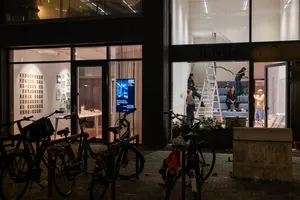
During the final week in Amsterdam, they hosted a hands-on, and sometimes hilariously, workshop, turning the Futures Hub into a makeshift driving range. Using ladders, cardboard, rope, golf balls, and duct tape, participants explored space through the rules of golf. The key question was: “What if the Futures Hub itself had to subordinate itself to the logic of a golf ball?” The workshop was both a playful and insightful experiment in spatial thinking.
Finally, when asked about their future practice, Michał and Anna reflected:
The Residency is part of FUTURES X MPB residency, supported by MPB, the largest global platform to buy, sell and trade used photo and video kit.
Supported by Amsterdams Fonds voor de Kunst (AFK).
Images © Michał Sita


Isaac Titsinghkade 6A-B
1018 CA Amsterdam
The Netherlands
Isaac Titsinghkade 6A-B
1018 CA Amsterdam
The Netherlands
© 2026 FUTURES Foundation
© 2026 FUTURES Foundation