Beneath the Surface of the Synthetic: Crafting AI with Care — An Interview with Sheung Yiu
November 17, 2026 — Xinyi Zhang and Payal Arora (Inclusive AI Lab, Utrecht University)
Sitting at the edge of the sea in a Hong Kong harbour, the young Sheung Yiu once wondered about the astronomical images in his science textbooks. More than two decades later, sitting by another stretch of the water—this time at the Amsterdam FUTURES residency, he’s still in his flip-flops, intrigued to explore facial readings in the age of face recognition and deepfakes.
Yiu is a Hong Kong-born photographer and researcher based in Helsinki, where he studies computational imaging. His route into the subject began long before the language of AI entered everyday life: with a childhood spent close to Hong Kong’s islands and the sea, stumbling into science, journalism, and photography, then, research into the systems behind technical images. That interest began with a stack of old science textbooks at home: their strange mix of scientific photographs, garish illustrations and stock images became The Poetics of Science, an early research-based series on how scientific images acquire authority through context. His turn towards a slower photographic practice was also a response to the speed of journalism. “I worked as a photo editor,” he recalls. “The news cycle moved so quickly that there was very little time to understand the images passing through our hands.” Most days meant receiving photographs, writing captions and uploading them; there was rarely time to make photographic stories. Moving to Finland gave him time and institutional support to stretch the time needed to build the stories behind the images.
During the pandemic, he photographed every object on his desk and rebuilt them as digital twins. The more precisely he reconstructed their surfaces, the clearer their absence became. He also tried to recreate the smell of old comic books stored in Hong Kong—the humidity, aging paper, decay and microorganisms; the smell that we all carry, tracing where we come from and how we have moved through time to arrive here today. “A model may reproduce the appearance of an object,” he says, “but it doesn’t contain every microorganism, material change, or sensory association that gives the object its history.” The experiment gave him a question that continues through his work: what does a technical image capture, and what does it leave out?
The shift from objects to faces sharpens the same question. A model can copy and measure a face, but can it read and understand a person? Drawing on Pope Leo XIV’s Magnifica Humanitas he has been reading, Yiu puts it plainly: “Human limitation is not necessarily a flaw. Work and creation are part of human life, so automating image-making may remove something rather than simply liberating us from labour.”
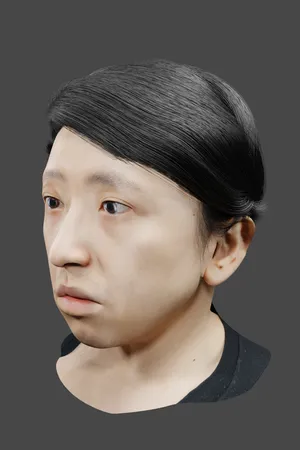
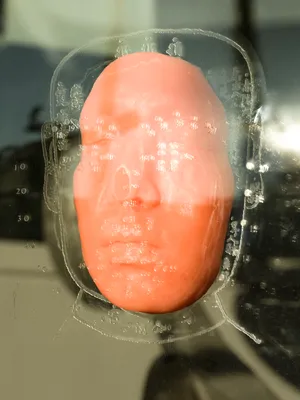
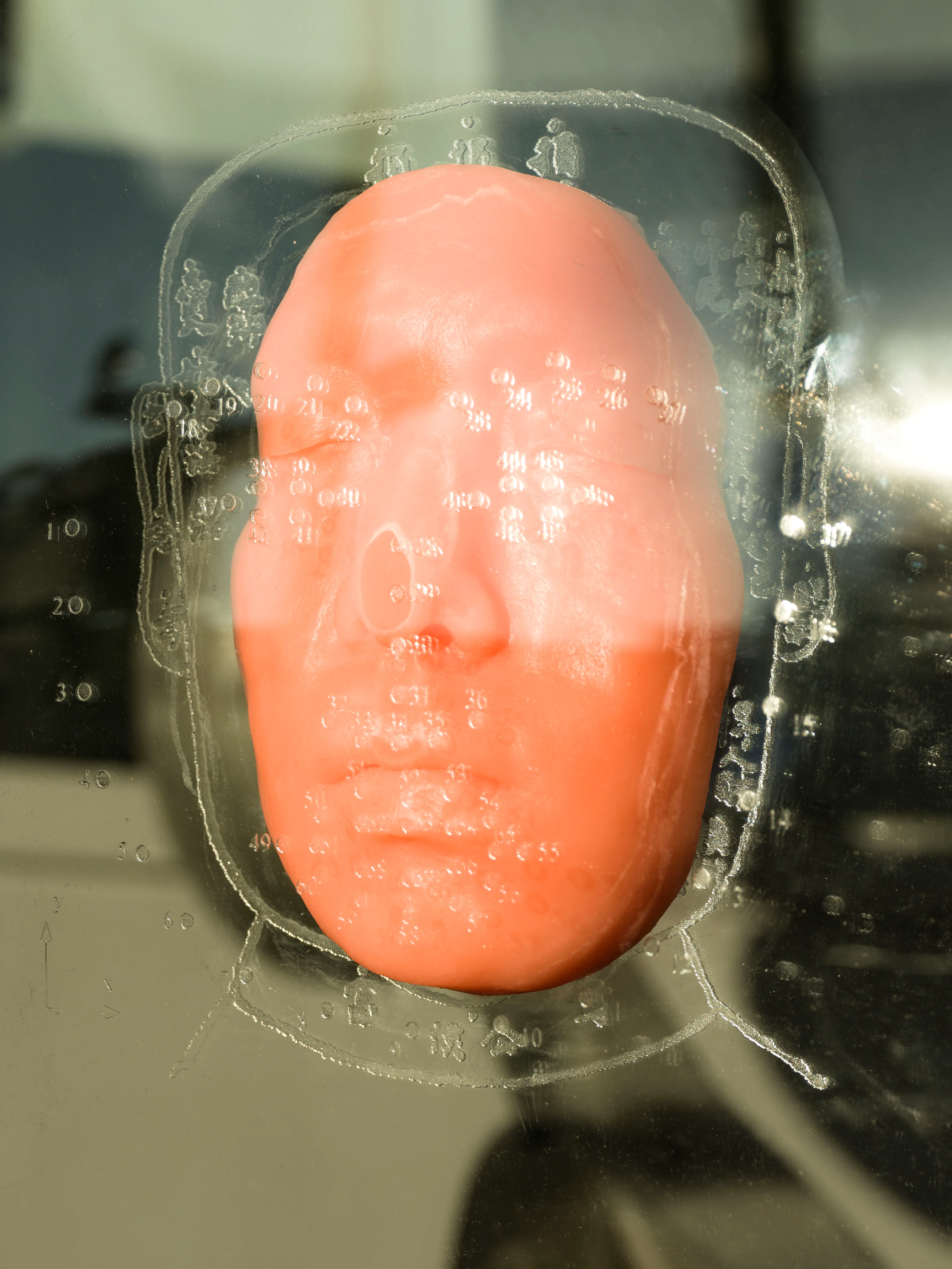
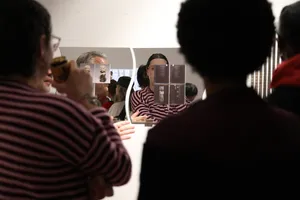
He becomes visibly animated as he opens a book on Chinese face reading, pointing to the moles, lines and features once used to read character and fortune. The residency studio around him has a slightly theatrical feel of a backstage set. Two large photographic mosaics, built from thousands of synthetic faces, dominate the room—unfinished works from a project that places East Asian face reading, Western physiognomy and contemporary facial recognition in the same frame. For one element of the project, Yiu is working with over 3,500 images taken from a synthetic facial dataset, arranging them into a photographic mosaic that forms his own face. Many of the source images contain visible artefacts—traces of the speed and scale at which they were produced. The work is still developing, with the residency serving as a space for prototyping.
Facial recognition, he notes, also reduces a face to points and patterns, and has moved from matching identity towards predicting personality, sexuality and behaviour. “If mole reading is called superstition,” he asks, “could facial recognition also become a kind of superstition?” Yiu places the systems alongside one another, and asks how both turn facial features into claims about identity, character and the future. His concern, he says, is “the movement from matching to prediction and the assumptions embedded in that movement.” Asked what he hopes viewers will take from the work, Yiu says he wants them to see AI-generated images as “a facade of what’s deeper, which is the economic principle of scaling.” When the conversation turns to whether such technology should be trusted, he smiles faintly and folds his arms, with a relaxed but firm gesture, just like his attitude through all of his works: “I have to be careful,” he says. “I’m skeptical of what AI companies claim their systems can do.”
“Companies then treated that availability of data online as permission to extract the work and use it to train proprietary systems,” Yiu says,“I can be optimistic about technology, but I’m pessimistic about people who own the technology. Ultimately, it’s about power”—who holds it and who knows how to use it.
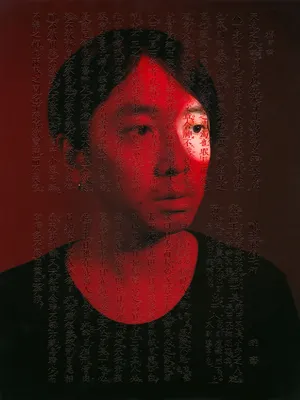
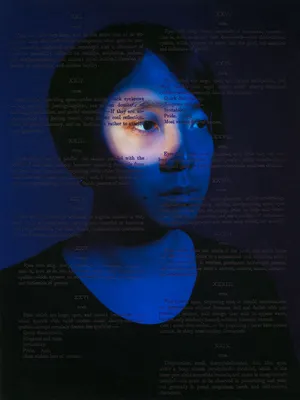
His skepticism lies in what he calls the routine “carelessness,” the casual indifference which makes the synthetic image’s quality “low”. In his current project, provisionally titled SI (Slop Intelligence), synthetic face data is produced at scale, often with visible errors, and are still used to train facial-recognition systems. He calls this “data slop,” and twists the industry’s promise of superintelligence, or SI, into “slop intelligence.” However, as he points out, “low quality alone does not make something slop.” It's whether it was handled with care: Was consent obtained when the data were collected? Who made the original images? How were they selected, and for what purpose will they be used? It also continues after generation: Are we reading statistical patterns as knowledge they do not actually contain? Who benefits from the system, and whose work is being exploited? Slop implies an attitude of thoughtlessness and wastefulness.
For Yiu, care is just an attention to the full chain of people, decisions and consequences behind the image. On its surface, an image mirrors the visible world; beneath it, the image carries the hands that make it, the systems that circulate it, and the intention with which it’s offered. Picture this, he says, taking us back to the child by the sea, arranging imaginary dishes in his toy kitchen for his parents: the meal need not be real for the act of making and offering it to carry meaning.

Isaac Titsinghkade 6A-B
1018 CA Amsterdam
The Netherlands
Isaac Titsinghkade 6A-B
1018 CA Amsterdam
The Netherlands
© 2026 FUTURES Foundation
© 2026 FUTURES Foundation