On process - Yujie Zhou in Conversation with Simone Zeefuik
On process - Yujie Zhou in Conversation with Simone Zeefuik
October 21, 2026 — Simone Zeefuik
With their sharp sense of patterns and courageously soft practice, Yujie Zhou wove FUTURES Photography into bigger pictures that are both sensory and sonic. Zhou, the Chinese visual artist based in Helsinki whose work centers around Jacquard weaving, photography, publishing and video, visited Amsterdam for the first time. For their 4 week residency they turned the studio part of their living space into an echoing of their work process. Their place was rich with wool, cotton, papers, books, playlists full of Chinese pop music from the early 2000s and occasional quiet moments. From there they flowed. They flowed towards and from language, continuously finding ways to speak and un-say, to code and uncover. When asked about their artistic genealogy Yujie Zhou credits Xu Bing. “He’s a Chinese artist known for printmaking. He very much shaped how I understand language. Through his work, I found ways to figure out what language means and I learned to approach it like poetry. There are a lot of things we can’t say. Or, we don’t know how to say them and we keep quiet. Silence can also say a lot, even when this silence makes a language become or at least appear invisible. I like to use this invisibility as a way of ‘language camouflage’. It makes me wonder about communication and the strategies we use to communicate. I consider weaving and other parts of my work to also be a form of language. They, too, can communicate what we find difficult to talk about.”
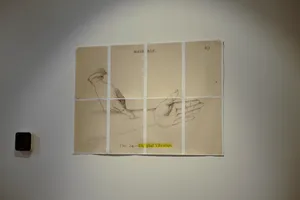
The space they’ve made presents itself as the home of a rigorous thinker. Facing the street, the wall on our right side holds a collection of black and white, xeroxed images that move between two of Zhou’s interests. “Lately, a lot of my work centered around weaving and for this I work with a loom. When working with this device, I often think about the connections between how we use our bodies and the way we use this machine. These images are from a book about the work of Dr. Gustaf Zander, who expanded upon Pehr Henrik Ling’s principles to create mechanotherapy using specialized exercise machines. What we’re seeing are drawings of people doing a variety of exercises but, it also looks like they’re in the process of weaving with a loom. By many people Ling is considered to be the first to study the scientific treatments of the body. Through my research,” Zhou chuckles, “I’ve learned that Ling from Sweden met Ming from China. Ming taught Ling about Tui Na, an ancient Chinese massage method that was used for military training. As a Chinese artist living in Finland I enjoy how I’m inspired by the work of a Swedish scientist who, in turn, was influenced by the teachings of Ming. It’s interesting how these things move.”
Zhou’s love for books brings us to the round, green mat in the center of their studio. On it we see a collection of books, fabrics and health hammers, one of Zhou’s recent projects. “I like exploring how different materials feel. And how different associations with these materials can perhaps change how we feel them. For example, with massages I’m exploring the overlaps between discipline and care. I choose materials and how I want to use them based on the concept I’m working on. For some works, my work about protesting and riots for example, I have used bricks and glass. I also worked with ceramics and created my own clay. But,” they say, hinting towards the health hammers, “I do prefer softer materials. During my residency at FUTURES Photography, there’s not much production work I can do. So, I do a lot of research. In preparation for the open studio and my workshop, I started making natural dye to colour small, square pieces of fabric. I made the dye from the food I ate. Grapes and curry, for example. I think it’s important to see how you can work with everyday materials.”
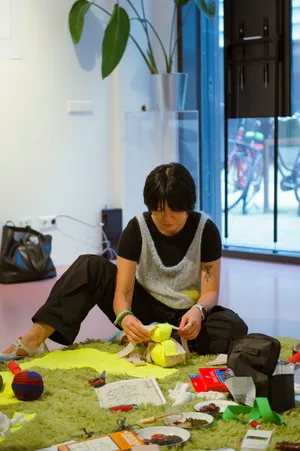
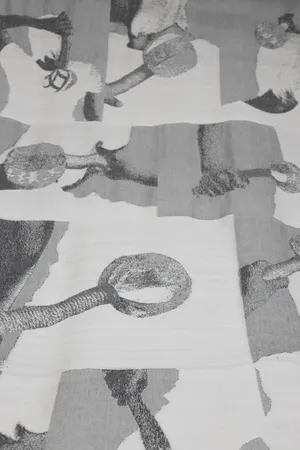
This incorporation of everydayness works perfectly in their space. “This place balances between the public and the private. The windows are very big and we’re facing the street. Throughout the day I see people walking or cycling by and,” they laugh as they nod, “they very much see me. They can see it’s a studio so my everyday life and the things I’m using almost automatically are seen as part of what is created here. That made me think about how what I eat and drink can also be part of what I’m creating. The same goes for my moments of relaxation. I enjoy watching Chinese cooking shows on Youtube. Now that people passing by can clearly see me do that, it makes me wonder about how sensations of memory and connection can be used in my work. Sometimes even when what we see is difficult to interpret.”
It’s a truth affirmed by a sentence written on the left wall of Zhou’s space: ‘I can’t translate this,’ it says. The words are written on piece of paper that was once used to label one of the archives of Amsterdam’s IISG, one of the many institutes Zhou visited for their research. “I got this paper from a box that archived old poems from Beijing. Someone at the archive must have tried to translate some of the words but, I think this note holds their conclusion: they couldn’t. I found that so fascinating because even without their translation the poem was already there. Isn’t that interesting?! Even when something is empty to someone now, you can always see that it was once very much alive.”

Isaac Titsinghkade 6A-B
1018 CA Amsterdam
The Netherlands
Isaac Titsinghkade 6A-B
1018 CA Amsterdam
The Netherlands
© 2026 FUTURES Foundation
© 2026 FUTURES Foundation