

![El cabal del riu [The River’s Course]](https://futures-backend-unstated-int.vercel.app/api/media/file/paula-artes-banner-300x240.webp)
El cabal del riu [The River’s Course]
Paula Artés
El cabal del riu [The River’s Course]
Nominated by Fundació Foto Colectania, 2026
El cabal del riu [The River’s Course] continues Paula Artés’s long research into hidden histories and power structures, developed through collaborative work with communities whose testimonies are absent from institutional archives. The project examines the RENACE hydroelectric plant on Guatemala’s Cahabón River. For more than two decades, it has restricted access to drinking water for Q’eqchi’ Maya communities along more than thirty kilometres of river. This must be understood within a long history of expropriation and territorial reordering. From the decline of indigo and cochineal to the imposition of coffee plantations and the coercive policies of the Liberal Reform, Guatemala has developed a model that subordinates land and resources to external interests. This pattern, inherited from colonial logics, persists today.The RENACE complex is a paradigmatic example. Neoliberal reforms in the late 1990s and early 2000s enabled privatization and large-scale concessions. Corporación Multi Inversiones (CMI) and Cobra (ACS) shaped a legal framework to their advantage. Opaque agreements and the absence of consultation created dependence and systematic rights violations.Water—understood by Maya peoples as a living being—becomes the project’s symbolic axis. Artés’s analogue photographs depict pipeline routes, retaining walls, eroded embankments, and abandoned machinery. These traces reveal irreversible transformation and industrial control while exposing propaganda narratives of progress.Developed with Q’eqchi’ leader Bernardo Caal Xol and local communities, the project continues Artés’s inquiry into how power operates through mechanisms that appear neutral but produce profoundly unequal effects. Her work functions as a device of visibility, revealing historical continuities of dispossession and resistance. Carolina Ciuti
![El cabal del riu [The River’s Course] artwork](https://futures-backend-unstated-int.vercel.app/api/media/file/el-cabal-del-riu-the-river-s-course-art-0-300x240.webp)
![El cabal del riu [The River’s Course] artwork](https://futures-backend-unstated-int.vercel.app/api/media/file/el-cabal-del-riu-the-river-s-course-art-1-300x375.webp)
![El cabal del riu [The River’s Course] artwork](https://futures-backend-unstated-int.vercel.app/api/media/file/el-cabal-del-riu-the-river-s-course-art-3-300x375.webp)
![El cabal del riu [The River’s Course] artwork](https://futures-backend-unstated-int.vercel.app/api/media/file/el-cabal-del-riu-the-river-s-course-art-4-300x240.webp)
![El cabal del riu [The River’s Course] artwork](https://futures-backend-unstated-int.vercel.app/api/media/file/paula-artes-thumb2-300x375.webp)
![El cabal del riu [The River’s Course] artwork](https://futures-backend-unstated-int.vercel.app/api/media/file/el-cabal-del-riu-the-river-s-course-art-6-300x240.webp)
![El cabal del riu [The River’s Course] artwork](https://futures-backend-unstated-int.vercel.app/api/media/file/el-cabal-del-riu-the-river-s-course-art-7-300x375.webp)
![El cabal del riu [The River’s Course] artwork](https://futures-backend-unstated-int.vercel.app/api/media/file/el-cabal-del-riu-the-river-s-course-art-8-300x240.webp)
![El cabal del riu [The River’s Course] artwork](https://futures-backend-unstated-int.vercel.app/api/media/file/el-cabal-del-riu-the-river-s-course-art-9-300x375.webp)
![El cabal del riu [The River’s Course] artwork](https://futures-backend-unstated-int.vercel.app/api/media/file/el-cabal-del-riu-the-river-s-course-art-10-300x240.webp)
![El cabal del riu [The River’s Course] artwork](https://futures-backend-unstated-int.vercel.app/api/media/file/el-cabal-del-riu-the-river-s-course-art-11-300x375.webp)
![El cabal del riu [The River’s Course] artwork](https://futures-backend-unstated-int.vercel.app/api/media/file/paula-artes-thumb1-300x240.webp)
![El cabal del riu [The River’s Course] artwork](https://futures-backend-unstated-int.vercel.app/api/media/file/el-cabal-del-riu-the-river-s-course-art-13-300x375.webp)
![El cabal del riu [The River’s Course] artwork](https://futures-backend-unstated-int.vercel.app/api/media/file/el-cabal-del-riu-the-river-s-course-art-14-300x240.webp)
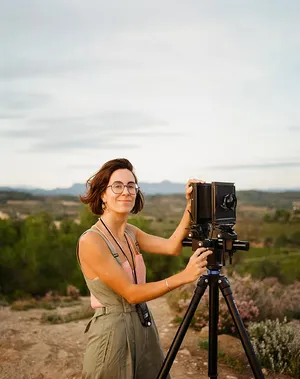
Paula Artés
Paula Artés (1996) is an artist committed to unveiling and questioning hidden spaces
of power—and, by extension, control. Through rigorous prior research, she brings
these spaces to light.
Her work has been exhibited at Museu Habitat, curated by Manuel J. Borja-Villel;
Santa Mònica in Barcelona; Lo Pati in Amposta; the Museu Morera; and the Festival
de la Imagen in Colombia. She won the ArtNou Award for Best Exhibition at àngels
barcelona gallery.
Her work is part of the Mapfre Foundation collection and the Contemporary Art
Collection of the Generalitat de Catalunya. She has been selected for PhotoEspaña
Descubrimientos, Sala d’Art Jove, VEGAP, OSIC, and Unseen Amsterdam. She has
also been nominated for the Gabriele Basilico Prize, the C/O Berlin Talent Award, the
MAST Foundation Prize, and the Pla(t)form Prize at FotoMuseum. Additionally, she
has participated in residencies at HISK in Belgium and Baladre at Lo Pati.
ProfessionPhotographer, Visual Artist, Educator, Researcher
IdentityWoman
LocationSpain, Southern Europe
PracticeConceptual, Landscape
TopicsSurveillance, Politics, Capitalism, Climate crisis, Anthropocene, Colonialism
CityBarcelona
Nominated byFundació Foto Colectania
Year2026
Close

Address
Isaac Titsinghkade 6A-B
1018 CA Amsterdam
The Netherlands
Address
Isaac Titsinghkade 6A-B
1018 CA Amsterdam
The Netherlands
© 2026 FUTURES Foundation
© 2026 FUTURES Foundation
Close