Centre photographique Rouen Normandie

Member from 2022. Located in Rouen, France

Centre photographique Rouen Normandie

Member from 2022.Located in Rouen, France

Today, the Rouen Normandy Photographic Centre has been awarded the title of "Centre d'Art Contemporain d'Intérêt National" and is continuing a story that began 30 years ago. It was the first place dedicated to photography in Normandy and one of the pioneers in France, at a time when photography was still a medium in the process of gaining artistic recognition in France. The Centre photographique Rouen Normandie is a place that exhibits and supports photographic creation and accompanies the public in the discovery of its multiple facets. The Centre has an annual programme of 3 to 4 exhibitions, complemented by off-site events in partnership with regional and national institutions (art centres, schools, hospitals, etc.) and a programme of artistic residencies. The Photographic Centre has an artistic line that places aesthetics as a vector of commitment at the heart of its programming and a cultural line that places a point of honour on the materiality of the work and what physical presence implies: the author's choice, the spectator's time.

Nominations

2026

While each artist has their own specific approach, they all address the question of the document and the photographic image as a place of memory or even belief.

‍

With Gaëlle Delort, it is the landscape of the Causses, where she lives, that is revealed through a long-term exploration using a view camera. Combining speleology with her photography practice, she captures the geomorphology of the region in striking underground landscapes. Venturing into places beneath the ground we walk on, she methodically probes and records the other side of the world, where the archives of the earth lie.

‍

It is the memory of human beings and their artefacts that Lívia Melzi seeks to highlight. Starting with the archives of the National Museum of Rio de Janeiro, destroyed by fire in 2018, she is also pursuing a long and extensive project of gathering material from the reserves of ethnographic museums. Based on these traces of the past, the Franco-Brazilian artist questions the future of their photographic collections.

‍

Sediments of beliefs, the photographic image gains a range of forms borrowed from the field of popular Mediterranean tradition in Emma Tholot's work. Her installations blend theatrical elements from religion, carnival and the circus. Migrating onto fabric, embellished with ribbons, bells, wax ex-votos, cushions and satin, the photographic image is the crucible of a collective memory with a baroque accent.

‍

Finally, the photographic document as deployed by Valentin Valette is shaped by his background in visual anthropology. The Franco-Algerian artist carries out photographic projects in the Gulf countries and is particularly interested in present-day Oman. In a large fresco combining documents, sound and photographs, he portrays migrant builders and entrepreneurs, and, isolated in vast desert landscapes, architectures that could be from the distant past or far-off future. Capturing faces and traces, he depicts a territory in transition, criss-crossed by migrations whose embodied lives are often erased, and patiently builds an archive of the time that once existed beneath these infrastructures of concrete and solar panels.

‍

The members of the jury:

Marie Magnier, Director of Filles du Calvaire gallery

Valérie Cazin, Director of Binome gallery

David Benassayag, Co-director of Le Point du jour art center

Fannie Escoulen, Independent curator, co-founder of Le Bal, Paris

Nathalie Giraudeau, Director of Centre Photographique d’Ile-de-France

Claire Tangy, President of Centre photographique Rouen Normandie

2025

Elliott Verdier heads off into the great cold, taking the road to the distant Bering Strait and a deserted island to document a wounded territory as much as to draw his own desire for decentralisation.

‍

Sixtine de Thé plunges into darkness with people who have lost their sight, with whom she considers, from a different perspective, what it is to see and to make images.

‍

Constantin Schlachter makes new tools for observing infra-worlds, also searching in the night of the darkroom to bring to the surface of the paper a material of dizzying depth.

‍

Maxime Guédaly puts the body in motion—his own and that of others, dancers and walkers—at the heart of his experience of urban and rural environments as a prelude to a renewed experience of being in the world.

‍

Nominators

Marie Magnier, director of the gallery Les Filles du Calvaire

Marina Gadonneix, artist

Emilia Genuardi, director of the Approche art fair

Valérie Cazin, director of the Binome gallery

Audrey Hoareau, director of CRP/Centre régional de la photographie Hauts-de-France

Audrey Illouz, curator

Anna Planas, artistic director of Paris Photo

Jordan Alves, co-director, Atelier EXB

Jean-Kenta Gauthier, gallerist

Marie Terrieux, director of FRAC Normandy

FUTURES Talents 2022, 2023, 2024 : Coline Jourdan, Pauline Hisbacq, Nolwenn Brod, Rebekka Deubner, Hélène Bellenger, Léonie Pondevie, Rebecca Topakian,

Arno Brignon, , Damien Caccia, Marc-Antoine Garnier.

‍

Final selection made by Raphaëlle Stopin, director and Claire Tangy, President of Centre photographique Rouen Normandie

2024

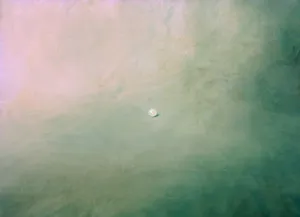
‍Léonie Pondevie's photographic form is composite, arranged by the aggregation of clues: contemporary shots, collected archive images and shared personal documents sit side by side on the wall like evidence of an ongoing investigation into complex and evolving realities. In Un point bleu pâle, Léonie Pondevie contemplates the sky and observes the weather. In the same way that her father would obsessively record rainfall levels and temperatures in small notebooks, she assembles particle images, waiting to be analysed. She subjects these images to a kind of poetic decantation: her father's notebooks and his measurements from another age, archive images of the village where he was born, press cuttings from the 1970s, the clouds in front of us at sea, a hand caressing an antediluvian granite and raindrops on the hood of a relative. The stratospheric and the extremely close, immensity and intimacy, impassive geological time and climatic urgency, it's all there, under the same sky. Placing her observation post at the heart of her family history, Léonie Pondevie eludes the Manichean demonstration: the photographic project, though wide-ranging, does not claim to elucidate anything, but sets itself up as a humble hypothesis. What Un point bleu pâle portrays is the act of human experience; not the thing, the climate, but the ways in which we take it into consideration, from the observer who guesses at its insignificance and modestly records the life of the clouds in little notebooks to the way they are boxed up by geo-engineers, neo-demiurges.  From these decanted images, the reflection of a distant land, with which we have lost contact, rises. The simultaneous and paradoxical measure of our insignificance and our power to cause harm.

‍

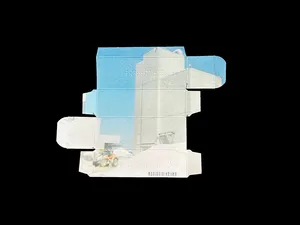
If Hélène Bellenger's work could be associated with a single tool, it would not be a camera, but one of those fine, precise instruments of the forensic scientist, so diligent is the artist in dissecting the workings of an imagery of perfect beauty and its artificial paradises. Preferring the act of collecting and transforming to that of shooting, she approaches images that are inert and out of use. For the Dazzled project, she collected a series of faces on the internet that had been obliterated by a flash of light - the now famous form of the selfie with the flash in the mirror - forming a kind of digital sun that contaminates the image and prevents the portrait. Another collection is that of advertisements for anxiolytics and antidepressants taken from specialist magazines, which she assembles into a frieze to display the litany of tense faces and slogans in the form of injunctions to happiness. Earlier, in Right color, she diverted a collection of magazines, posters and photograms from reels of films featuring actresses from the 1920s to the 1950s, reviving the make-up that was applied to them to reconstruct their faces and modify their plasticity for the black-and-white screen of the time. With her recent Bianco ordinario, her torsos of Apollo and busts of Venus, she continues her archaeology of the canons of beauty. Through a play of superimposed forms and supports, she links the geological time of the Carrara marble quarries, its extraction in Antiquity for sculpture, and today's massive extraction of marble powder to whiten the packaging of our cosmetics and cleaning products. The ensemble consists of a collection of unfolded packaging cartons on which the artist prints images of antique busts and quarry landscapes. In turn, the images themselves will be extracted from their support by the acidity of the marble powder contained in the cardboard, washing them ‘whiter than white’. The history and fortunes of the Western concept of whiteness are at the heart of the work the artist is currently developing in the Mediterranean basin.

‍

Photographic investigation has become, by force of circumstance and events, the form that Rebecca Topakian has adopted. As far back as 2014, in Jericho, she was documenting the mystery of the city known as the oldest in the world; in response to ancestral tales, she amassed photographic clues, temporal ellipses bringing together within the frame of the image the symbolic and the trivial, immemorial times and the present of the encounter. Since then, she has set out to tell a more personal story: that of her Armenian family, exiled from Turkey as a result of persecution. To tackle the dense, traumatic material of this long-silenced family history, she first turned to fiction. With Dame Gulizar And Other Love Stories (2017-2019), her starting point is the love story of her grandparents. From the knightly features of the story as it came to her, she drew the main lines of a narrative borrowing from mythology, the form of which already combines family archives and shots taken in Armenia. In 2021, the artist began Il faut que les braises de Constantinople s'envolent jusqu'en Europe, this time embracing the whole of her family history. With a single artistic gesture, she gathered together the scattered snippets - rare documents and sparse accounts - and took them there to perhaps, if not repair the family history, at least repair its narrative and by extension contribute to restoring the narrative of the Armenian genocide. Her genealogical research takes her to Istanbul, Talas in Anatolia, in the traces of her family's village, and leads her to cross paths with Armenians in present-day Turkey. The photographs are accompanied by short texts that, like the photographs themselves, are devoid of pathos and focus on the reality that is there, on what persists: the youth, a stele engraved in a cemetery, and despite history, racist flags and tags in the streets and on the walls of villages that have already been devastated. Patiently, the artist continues his work, recording, assembling and maintaining the embers of memory.

‍

Rebekka Deubner's work is full of narratives of metamorphosis, as close as possible to the earth and the bodies it carries. From the prefecture of Fukushima, where she made her first visit in 2014 and will return on several occasions, she has brought back indexical images, faces taken from encounters, seaweed and other living organisms she came across while wandering on the edge of the forbidden zone. Scattered into fragments by the catastrophe, they are traversed by the same palpable quivering, exuding signs of persistent vitality. The material of these bodies, the fluids that emanate from them and that they exchange, framed as closely as possible, are at the heart of the work entitled En surface, la peau, produced in the intimacy of the artist's love life. The act of photographing retains desire, counters its volatility, and ward off its loss. From this intimate exploration of the body and its profound movements, she moves on to the body as political territory, with Les saisons thermiques, an ensemble dedicated to male contraception. Here we find her way of slowly approaching the body and restoring its tender plasticity. In these bodies standing close to her, an alternative representation of masculinity is embodied. Framing and squeezing again with Strip, a work in progress made up of photograms and videos in which the artist attempts to become one with her late mother. Dressing her clothes and underwear, like counter-forms that still carry within them the latent trace of the body and epidermis that inhabited them, slipping into them and, in video performances, tying them up, patching them up and covering herself in them. Alongside these short films, Rebekka Deubner combines a collection of photograms of clothing, also fragmented, which, reassembled on the wall, sketch out the contours of a vast, warm body.

‍

2023

From his experience as an educator on the edges of Toulouse, Arno Brignon (1976), keeps an appeal for works built in a collaborative way, often within the framework of workshop and residency projects rooted in urban or rural contexts. Invited to Aussillon (South of France), he works in a housing area undergoing rehabilitation and occupies an apartment in one of the deserted buildings to live, photograph and arrange meals; the practice of portraiture becomes one of the ways in which he recreates, with the inhabitants, the memory of the place. In Valparaiso, he employs the calotype process to express the alteration of memory and the disappearance of the social bond. Gradually, the photographer moves towards an assumed onirism, embracing the random, seeking the accident. Recently, he went on a photographic trip to the United States with his family in the form of a road movie (Us, 2018-2022) in which photography serves as a link, both with strangers he met along the way and with members of his family. His use of outdated analogue films, products of a past industry, entrusts his photographic act to the erosion of the film, leaving room for the work of time.

‍

Damien Caccia's (1989) photography fits into a pictorial practice. His painting, initially figurative at the end of his studies, becomes more and more abstract. The figuration of the matter becomes little by little its theme, and the painter scrapes so much and more until preserving only the trace of the gesture which affixed the color. The canvas becomes the place of a former action of which is preserved only a mark more and more evanescent, altered. It is for its quality of residual imprint that the painter seizes photography. At one time he undertook to record with a portable scanner the entirety of a garden in order to restore it in the form of a large roll of paper, via fax. Later still, it is the screen of the telephone whose memory he comes to probe, seeking beyond the screen saver to find the ghostly image that this one comes to dissimulate. With Tears (2015-2022), he creates an attention-grabbing set: tiny details, insignificant moments held, somehow, on small surfaces (fine drops of glue) similar to damaged lenses.

‍

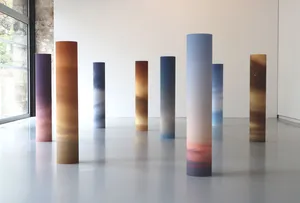
Folding, assembling, piercing, braiding paper: the work of Marc-Antoine Garnier (1989) thwarts the two dimensions of the photographic cliché. Is it photography? The act of taking a picture is only a preliminary, the existence of the future image is played out in other gestures, subsequent, which come to build a space of paper surfaces. Large rolls of sunsets arranged in a blank room recreate a colored harmony, a dappled blue sky sees the course of its clouds replayed by the cutting of the framed image into several wavy strips. At the beginning, there is thus Marc-Antoine Garnier who photographs not so much "on the motif" as the pattern itself, sensing the gestures, often multiple, that will accompany it to put it back into space. His pattern is always natural; his basic material is the infinity of the great elements. Recently, he plunged into the vegetal infinity, the lens in a jungle of branches or a forest of petals, to go and look for, on the surface of their image, the perceived form still contained in the thickness of the paper: the long and fine foliage are braided and find their indocility and the speckles of bunches of flowers, by scraping, to resurface.

‍

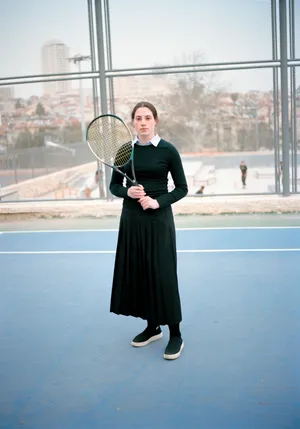
At the heart of Nina Medioni's (1991) photographic form lies the encounter and the long time. The photographer invests places sometimes linked to her personal history, sometimes unknown. In her survey, the camera becomes a tool: a box to record the territory through which she passes. She often chooses the summer time, dilated, without any apparent event, indolent. The event then, the one by which the image will come about, is the encounter. To bring it about, there is the presence, unusual in these environments, of the camera and the spoken word. It is not surprising then that we often find in her photographic projects, series of images, portraits and gestures taken in the same time-space. None of the portraits in the same shot take priority over the other, she explains. She places them on the page, careful not to cut their speech; it is then up to us to read the transcript of the words exchanged with this young boy from Prépaou, a small residential town in the South of France. Recently, she realized in Israel, The Veil (2019-2022), a photographic project of greater scale. There she surveys a distant, unfamiliar family territory and seeks through photography and portraiture to weave a heretofore non-existent link. The camera is then a limit-space, where to try to meet the members of a part of her family that she does not know, belonging to an orthodox Jewish community. The photographic image will record here the attempt of confrontation, the elusive success or the failure. The photographic surface then embodies the threshold on which the photographer and the photographed stand. Recently, she directed Le Chalet (2022), a short film about a mysterious house in the 19th arrondissement of Paris, inhabited by her uncle. The meetings with the residents, young and old, of the neighborhood, the brief or recurring dialogues make emerge the contours of a "chalet" planted on the boulevard, which she will always make sure to leave in the background. In Nina Medioni's work, the photographer's taking of the image and the person being photographed's taking of the words are definitely linked.

2022

Anaïs Boileau, whose activity is divided between work for the international press and personal work, was assiduously engaged during the confinement in plastic experiments. The resulting photographs are a kind of palimpsest of her photography, striking a subtle balance between the documentary aspect of her practice and her undiminished appetite for shapes, colours, materials and their interactions. Deploying her studio outdoors, she places everyday objects and materials within the frame of her photography, which she then brings to life, sometimes seeking harmony, sometimes dissonance. Sometimes, she supports the pictoriality by introducing paint, blurring a little more this play of surfaces. What is then printed on the skin of the image is as much the result of her gesture of composition as the effect of the indelible imprint of the Mediterranean sun, the primary subject of all her photography.

‍

Nolwenn Brod's practice does not play with formal experimentation in its current sense, no overflow towards sculpture, painting or any other way out. It is a mining photography, which digs into its subject, in the duration, in the thickness of the blacks of the photographic image. As the projects follow one another, we observe the photographer in search of her relationship with the other, a journey for which photography is both the witness and the vehicle. The elsewhere of the residency, the exogenous anchoring point that it embodies, constitutes her privileged mode of operation. Recently in Beirut, Lebanon, in Lodz, Poland, or more recently in Brest, France, she slowly enters into a relationship, according to the encounters, which soon take shape in photographs, in the depths of the being and its contrary movements, between vulnerability and strength, fragility and affirmation. To the portraits, she adds fragments of bodies, details, nocturnal landscapes in the half-light, fragmented interiors, like so many points of this delicate cartography of the elsewhere that constitutes the other. The work is done in the length of the relationship and soon also in that of the filmic space which she decides to invest fully for her latest project Les hautes solitudes.

‍

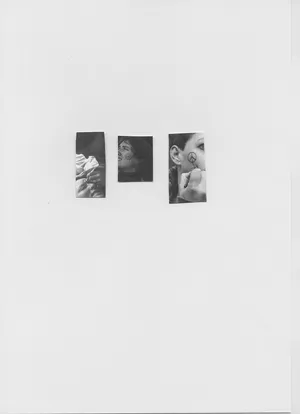
Pauline Hisbacq's images take their place in the great white of the page; frail presences, in appearance.

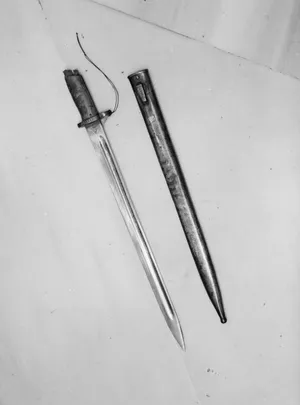
Whether she is the author of the photographs, as in many of her projects, or whether she makes use of archival images gleaned from the Internet, she applies the same gesture: she samples, deliberately focusing on the fragment. By its very nature, the photographic image is framed in a way that does not hide the hand's gesture or its imperfections. The fragment is then placed on a single sheet of paper, often in correspondence with another composition, in the pages of a book (the editorial form is dear to the artist) or on the exhibition wall. Recently, Pauline Hisbacq shared her Songs for Women and Birds, a series of collages tracing her reading of the first large-scale feminist and environmentalist movement that took place in Great Britain in the early 1980s. From the archive images, she retains those in which gestures of solidarity are prominent and deliberately avoids explicit illustrations of repression and violence, only a few framed primers surreptitiously recalling them. The interplay of hands, the interlacing of arms, the embraces call for our full attention. In this space of the sheet, Pauline Hisbacq then takes us, as she was able to search for the image among the flow of the Internet, to make our own way towards the image, towards the history of the relationships of sorority and mixed power that unfold there, and to listen to the voices, songs and cries of which this large white space is an echo. The murmur of the image, with its discreet hold on the page, and the modesty of the tool, photocopy and scissors, make a great noise in her work and are enough in themselves to open up a new mode of narration.

‍

‍Coline Jourdan recently undertook a residency in the South of France, in a project that is both documentary and visual - Raising the Dust - which explores an old arsenic mine and the visible and invisible impacts of the pollution caused by its exploitation. The photographer had already expressed her desire to image the natural landscape altered by human action. Her first works immediately took the path of experimentation, attempting to make a direct imprint of the polluted landscape on the surface of the film by immersion. Her documentary requirements quickly led her to make her approach more complex and to take care to avoid any systematism in these experiments. The photographic treatment of the image will then give prevalence to the narrative capacity and the experimentation will be carried out in a strict rigour of appropriateness, welcome in a photographic artistic landscape over-saturated with plastic experiments carried out on the account of ecological disasters. Rather than the immersion of the medium, of the film, it is our own that she engages with Raising the Dust. She now handles several types of images: sober frontal shots are applied to the rocks that have been removed, large colour landscapes unfold a seemingly sublime nature, other black and white shots reintroduce the scientific gesture... So many layers that translate the cohabitation of ambivalent realities and feelings in the perimeter of the mine and its surroundings.