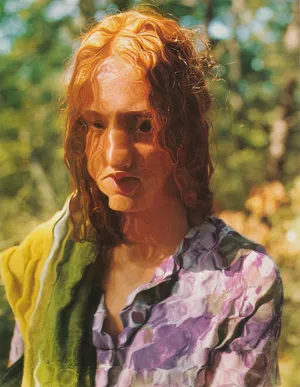


Tamara Janes


The two artists selected by Photo Elysée for FUTURES in 2023 are Tamara Janes and Florian Amoser. On the basis of their age alone, they would both seem to be beyond the category of emerging artists. However, their biographies show that they have had lives before being artists - Janes as an art director and Amoser as an architect. It is interesting to mention this fact, not as a disclaimer, but for two reasons that are relevant to our choice on a meta-level.
First, it reflects a general sociological fact that is representative of the arts field today: that of the hybridity of creative professions as well as lifelong learning practices. This means that an overly narrow definition of what it means to be an emerging artist doesn't reflect the realities of the lives of many creative people today. On a second level, these previous lives - at least from our perspective - have influenced the attitudes and methods of these two artistic positions and how they approach, analyse and help to reshape how we can perceive contemporary conditions and conditions of the image.
Although the results of their work are very different, both aesthetically and philosophically, there are similarities in the way they frame their mission. Both approach their work as long-term processes of artistic research, and for both the apparatus of the camera, as a technological determining factor, and the dispositive, as an important presentational framing device for the perception of images, are important elements in their respective thinking and artistic practices.
Based on these notions, both could be characterised as 'imagineers' in that they consciously question, reconstruct and engineer both the production and perception of images - whether pre-existing or of their own making. Both artistic positions present new ways of dealing with data-based realities and how to manipulate them. They challenge and expand conventional definitions of what photography and cultural heritage can be today.

Tamara Janes
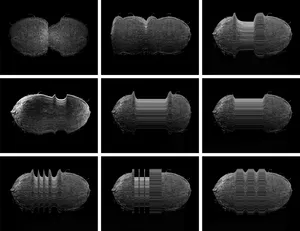
Florian Amoser, Splicer
In «Perspective as Symbolic Form», Erwin Panofsky describes the perspective as a representation of a perceptual scheme of an epoch. Linear perspective has been around since 14th century renaissance. In the meantime, digital technologies have introduced new forms of representation and representation techniques. These developments have challenged traditional notions of perspective and representation and continue to shape our understanding of the world and how we represent it. Over the last years our cameras have become computationally enabled. Today’s photographic apparatus are much more than just devices for capturing light and producing images. They incorporate complex computational processes that filter, transform, compare, reconstruct, and interpolate the data they collect in order to produce the images that we see. This has led to a situation where the images we see are no longer simply a direct translation of the physical world, but are instead the result of a complex interplay of technical, cultural, and social factors.
The global network of development, supply, and production of computing and camera devices shapes our common perception of the world. This shift raises important questions about the accuracy, reliability, and veracity of images, and the ways in which they may shape our beliefs and understanding of the world. As such, it is becoming increasingly important to be aware of the ways in which the images we see are produced and the factors that influence them, in order to better understand and critically evaluate the representations of the world that we encounter.
Over the last years and as a reaction to these developments, I have been imagining, prototyping and building «splicer». Building my own imaging device, can be seen as a political act of taking back control over the representation of my surroundings. Rather than relying solely on commercially available products that may have their own biases, limitations, and constraints. I learn the involved technologies, source surplus parts and build my own device. By doing this, I am taking an active role to photograph the world closer to a way in which I perceive, experience and understand the world around me.
Splicer is a new photographic apparatus that goes beyond rectilinear perspective, and enables me to explore new possibilities for representing and understanding the world. Splicer is a visual sampler and creates new visual matter from already known physical objects. Splicer takes post-rectilinear (or non-linear photographs) both in the dimensions of space and time. Creating new visual matter trough sampling elements from different sources opens up the potential for a more dynamic and flexible form of representation and indexicality, that may respond to the complexities and multiplicities of the world around us.
Image Captions:
Img 01: Single line array sensor for splicer, sourced via ebay from industrial surplus in South
Korea, september 2018
Img 02: View of the horizon, static, no filter/R/G/B/RGB, september 2019
Img 03: Prototype camera module v1 for splicer, summer 2020
Img 04: Splicer documentation, connection from splicer controller to trigger the capture of an
image, autumn 2020
Img 05: Splicer experimental setup, work in progress, december 2020
Img 06: Esslöffel, splicer, a
Img 07: Kokosnuss, splicer, april 2021
Img 08: splicer, august 2021
Img 09: splicer study #1 (perspective bubble), august 2021
Img 10: splicer study #1 (perspective bubble), fragment, august 2021
Img 11: sample movement for splicer study #1 (perspective bubble), august 2021
Img 12: Blutorange, march 2023
Img 13: The 9 axis of motion control of the final version of splicer, september 2023
Img 14: splicer study #2 (bouquet macabre), looped photograph, 1.5 x 19m, may 2023
Img 15: splicer study #2 (bouquet macabre), fragment no. 10, may 2023
Isaac Titsinghkade 6A-B
1018 CA Amsterdam
The Netherlands
Isaac Titsinghkade 6A-B
1018 CA Amsterdam
The Netherlands
© 2026 FUTURES Foundation

Close