The FUTURES
Residency Program
The FUTURES Residency Program provides emerging artists with time, space, and resources to develop new work, emphasizing artistic process and research, while offering opportunities to push the boundaries of their practice and engage with contemporary themes.

residency theme
how it works
program
At the beginning of 2025, FUTURES introduced a Research Residency Program across three locations: FUTURES Hub in Amsterdam, Capa Center in Budapest, and ISSP in Riga. Selected from a pool of nominated FUTURES artists, participants are chosen by a diverse panel of experts. Open to all artists nominated in previous years, the program aims to foster production, exchange, and meaningful artistic growth. Applicants are evaluated based on their artistic practice and the quality and relevance of a residency project developed specifically for their time with FUTURES.
- Professional Mentorship: Residents receive tailored mentorship from experts relevant to their project, offering guidance and support throughout the residency.
- Public Engagement and International Exposure: Each residency concludes with a public event, and the artist's work is promoted through communication channels of FUTURES.
- Fair and Inclusive Working Environment: The residency ensures fair pay, safe working conditions, and a commitment to inclusivity.
- Access to the FUTURES local network and introduction to Amsterdam art and contemporary culture scene.
from the residents
- Residents are encouraged to maintain a Visual Diary, posting weekly updates about their creative process on FUTURES’ social platforms. This offers an inside look at the artist’s journey.
- A Video Portrait is created during the residency, offering a personal insight into the artist and their practice. This video is shared through FUTURES’ platforms, extending its reach.
- A public-facing event, such as an open studio, workshop, exhibition or artist talk, is an essential component. This event offers residents a chance to share their work and process with the local community. This will also be live-streamed, allowing international audiences to engage with the residency's work.
- Interview with a local writer about the artist's creative process during their residency. This written interview will be featured on the FUTURES website, offering further insight into their work and artistic journey.
residency locations
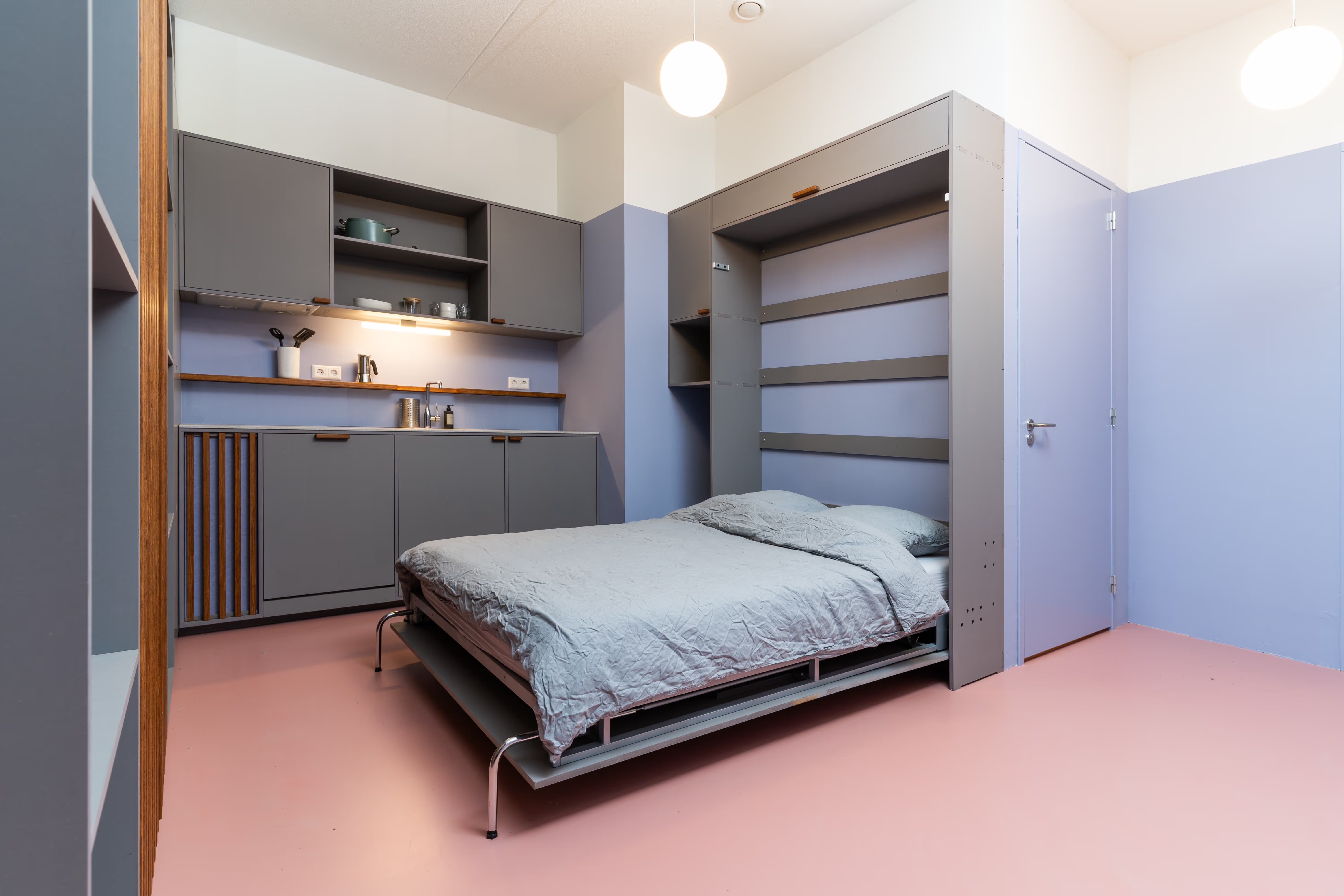
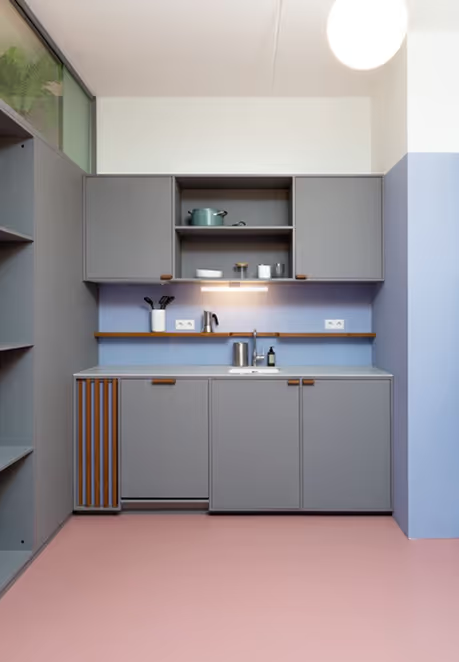
Futures Hub, Amsterdam: In 2023, FUTURES launched its first residency program at the FUTURES Hub, a vibrant space in Amsterdam that serves as the platform’s global headquarters and flexible exhibition venue. Situated on a former industrial site, the Hub offers a fully equipped live-work environment, including an atelier, furnished apartment, and event space. It welcomes artists from diverse regions and cultural backgrounds for both short- and long-term stays.
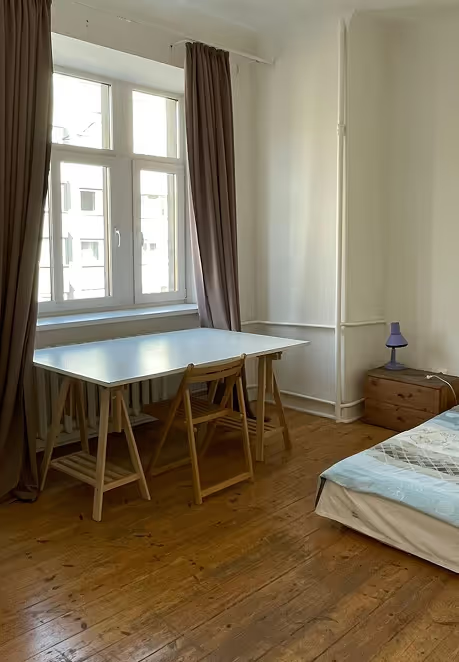
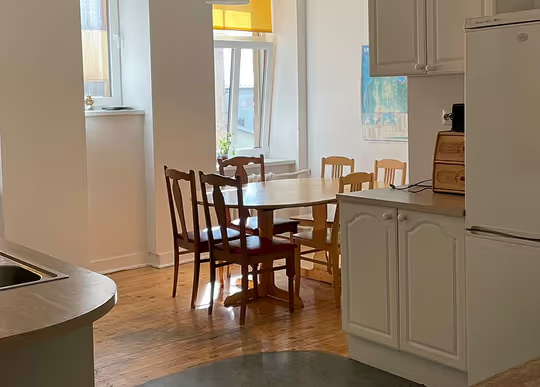
ISSP, Riga: The resident will be housed at the ISSP Riga Residency apartment in the city centre, shared with other two artists. The accommodation offers comfortable conditions for living and working - a separate bedroom with a working space, spacious shared living room and a fully equipped kitchen. The resident will have access to ISSP office facilities including use of printer, scanner, ISSP photography library and studio lights.
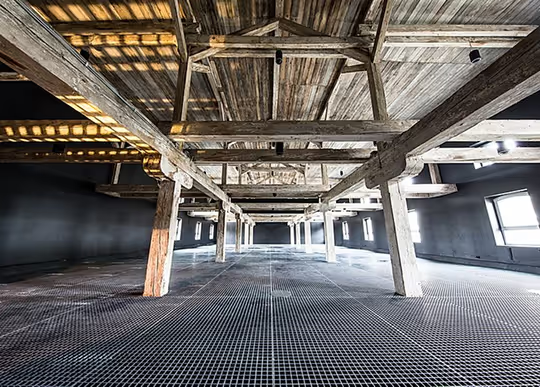
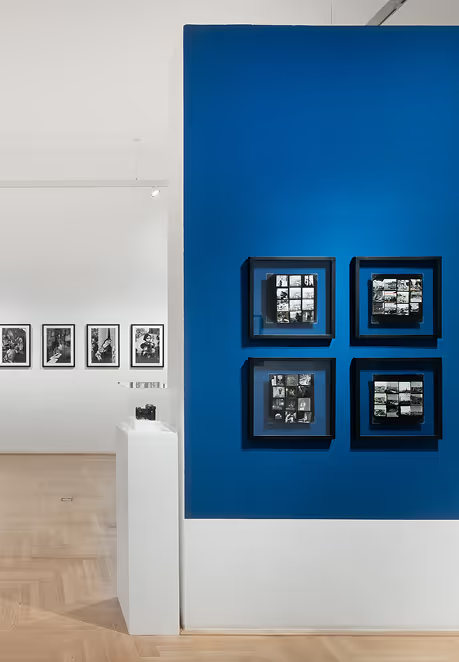
Capa Center, Budapest: The Capa Center residency program offers all entering participants a fully furnished private room within a communal apartment located on the Art Quarter Budapest premises, a studio space catering to the project’s requirements within its 400 m2 shared studio in the coolest postindustrial area of Budapest. Capa Center provides varied services to integrate the residents into the local art scene and contribute in establishing professional connections that best support their work and career. In addition, the residency will offer the possibility to organise a presentation at the Capa Centre in downtown Budapest, and use the Capa Centre's office facilities, including the printer and scanner.
Residency Archive
Katerina Tsakiri was born in Athens in 1991 and she is based in Gothenburg, Sweden. She studied Photography and Audiovisual Arts in Athens and has an MFA in Photography from the University of Gothenburg. Since 2015 she has been working part-time as a visual artist and part-time as a commercial photographer. From 2019 she has been devoting her time to her artistic practice. She works with self-portraiture and her subjects are mainly autobiographical. The theme of her work is the female identity in Western culture with a focus on the female body. Her practice expands from staged photography to video performances and sculptures. In her latest project, she uses documentary photography to share the journey of her breast cancer treatment. She unravels through the photographic medium her body’s fragility and the impact of the illness on her female identity.
Aurélie Bayad was born in Bordeaux, France, in 1994. The artist currently lives and works between Antwerp, Ghent and Brussels.
The addictive force of the internet is real, and no one knows this better than Aurélie Bayad. In a post-internet world, where IRL increasingly merges with URL, new possibilities of being are creeping into our daily lives. In her versatile art practice, Bayad uses video, photography and performance to confront us with the messy, dirty thoughts and desires of our hyperreal (what is real?), cultivated identities, as we try to live up to the new rules and standards set by the digital sphere of fake likes and dark web eroticism. Bayad uses her camera, her own and other bodies, and texts she wrote to create a fresh aesthetic language for the new desires of contemporary culture. In slimy and gooey, ugly and disgusting, cheap and glittery settings, we watch her unfold the personae of her filmed and photographed subjects. She hides her models behind the soft, nostalgic hues of the kitschy eighties and nineties; includes erratic and ecstatic sequences in her films, with heart-pounding soundtracks; and fearlessly looks back into the lens, as if asking us: ‘What is your real personality? What is real beauty? What is your true desire, your fetish? Who do you want me to see?’ With her otherworldly beauty standards, her visceral and vomitous but lively encounters with food and other quotidian objects, and her frank interrogations of intimacy, giving and receiving, love and abuse — so pertinent that they can make you tremble with self-doubt — Aurélie Bayad shares with us her search for personal grounding in this confusing, networked world.
- Text by Zeynep Kubat (.tiff)
Zsuzsi Simon (b. 1988) is a photographer and videographer living and working in Budapest. In 2015, she graduated from the Intermedia Department of the Hungarian University of Fine Arts. Her research interests cover questions of feminism, body image and activism. The ways in which women think about the world is also central; she is particularly interested in the image of the female body and the expectations that come with it. Through close collaboration with groups of women – and a trademark blend of humour, provocation, irony and honesty – Simon aspires to break down various taboos. More recently her work has explored masculinity, and the role of the male muse from a female perspective. Simon is a member of Secondary Archive, which brings together women artists from Central and Eastern Europe for greater visibility.
Website: linktr.ee/zsuzsannasimon
Instagram: zsuzsi___simon
Hanane El Ouardani (NL, b. 1994) lives and works in Amsterdam, where she graduated from The Hague’s Royal Academy of Art in 2018. The Dutch-Moroccan photographer was born in the Netherlands with bicultural roots, and her practice reflects a recurring duality: on one hand, an unwavering desire to truly feel at home somewhere, and on the other, embracing her status as an ‘outsider’ due to the unique perspective it offers her, allowing her to keenly observe differences from a distance. In 2018, she published the photo book ‘The Skies are Blue, The Walls are Red’, a visual diary that explores the various layers of a diasporic identity. The book raises questions about representing one’s roots without feeling estranged from one’s own culture.
Drawing inspiration from clichés and contradictions, her work raises questions about identity, exotism, contradictions and social status. She dissects the layers of these themes, often starting from a personal narrative, which organically speaks to a collective spanning different cultures.
El Ouardani takes her camera to places where men are prominent in public spaces. As she actively interacts with them as subjects, she insists, “ I believe it’s crucial for the female gaze to participate in uncovering masculinity’s place in our contemporary world.” Her work has been exhibited at notable venues, including the Van Gogh Museum, Unseen Amsterdam, Foto Tallinn and Paris Photo.
Nominated for Futures by FOMU, Thomas Nolf (1986) was born in Kortrijk, Belgium. He is currently based in Brussels.
The work of Thomas Nolf examines the ways in which national myths are formed, instrumentalised and frequently suppressed. Confounding fiction and documentary, fabled event and scientific enigma, his work looks into how nation-building ideology influences modes of storytelling, and vice versa. Nolf handles his subjects with a close appreciation of narrative and its ambiguous relationship with veracity and considers the ways in which heritage and eroded beliefs can be re-established and repurposed.
For his long-term project Peculiar Artefacts in Bosnia and Herzegovina - an imaginary exhibition, for example, Nolf’s point of departure was the so-called “Bosnian pyramids” and other disputed historical sites and artefacts, including stone spheres and medieval monuments. Juxtaposing his own documentary work with kitschy acrylic paintings of dream-like, bucolic landscapes and an assortment of found photographic footage —including shots of a triangular mountain looming over a scenic village and a shepherd carrying a sheep on his back — Nolf keeps adding elements to our already confused reading of the phenomenon, its emergence and reception. By doing so, he revives the public controversy over the existence of an ancient civilisation in the region.
Drawing on the mythological dimension of the triangle-shaped hills, Nolf proposed an exhibition that would exploit the stories and objects surrounding the “Bosnian pyramids” to the National Museum of Bosnia and Herzegovina, which, in 2012, had temporarily closed its doors due to a lack of state funds. If myths and legends have proven to be valuable assets in branding a particular place as a unique tourist experience, its effectiveness in generating local informal economies might as well be explored.
Even if Nolf’s project-based practice is driven by a pragmatic desire to formulate alternatives to the status quo, he poetically engages with particular sites and times, carefully tending to a range of subjects — from the promise of a desirable ancient past to the current funding realities devastating cultural institutions in post-war Bosnia-Herzegovina — while, at the same time commenting on photography's rhetorical qualities and its — at times deceptive — relationship to representation and truth-telling.
Text by Laura Herman
He is a Colombian-Spanish artist and writer. He has participated in different festivals and exhibitions, both individual and collective, in Spain, México and Colombia.
Sebastián has used different disciplines such as photography, writing, sound and video to explore a variety of topics related to fiction, poetic strategies and landscape.
He also has published two books of literary fiction. The first, Tartamudo, published in Colombia, addresses the issue of stuttering from a choppy and fractionated writing. The second, The Secret Sound of the Stars, published in Mexico, is a children's book that tells the story of a kid who doesn´t sound at all.
On the other hand, Sebastián has been a professor of photography and art processes in Colombia and México.
He lives and works in Madrid, Spain.
Adi Tudose (b. 1987, Bucharest) is an artist-photographer based in Budapest. After completing his studies at The National University of Theatre and Film, he further expanded his artistic vision through experiences in Milano. He is pursuing an MA in Photography at Moholy-Nagy University of Art and Design, where his practice continues evolving. For him, the camera is far more than a tool—it is a medium through which he connects with the world around him. The streets become dynamic, ever-changing spaces where unpredictable encounters unfold. Immersing himself fully in these environments, Tudose approaches his subjects with empathy and sensitivity, capturing their lives with care and revealing emotional depth and vulnerability.
Tudose can transform fleeting, transient moments into cohesive compositions, bringing order and harmony to the everyday. Through this process, he taps into the subconscious, offering viewers a sense of unity within the chaos. His seamless blending of form and content sets him apart, creating simple yet mysterious representations. His work is characterized by cohesive framing, a rich interplay of diverse elements, and tuned figure-to-ground relationships. Tudose’s work offers an invitation to reflect on what photography can reveal about the human condition. Each frame carries layers of emotional and sociological insight, capturing the essence of his subjects while creating space for the viewer to connect with them on a personal level. Each photograph becomes more than a visual representation; it transforms into a deeply felt emotional experience.
Empathy and vulnerability lie at the core of Tudose’s creative process, enabling him to form deeper connections with his subjects and uncover meaningful relationships that might otherwise remain hidden. His work seeks to evoke genuine emotions, delving into themes of social and gender representation while fostering a sense of belonging. In doing so, he transforms emotional disconnection into moments of peace and truth.
As an artist, Tudose is committed to long-term projects that tell meaningful stories, ones that challenge him to confront fear, embrace vulnerability, and transform his personal experiences into shared human truths. His photography doesn’t just document—it transcends, offering symbols of connection and hope in a chaotic world.
Hanna Jarzabek (1976, Poland). She finished a Master degree in Political Science and worked on refugee reports for UN agencies such as UNRWA and UNCTAD. She developed her passion for photography while traveling (the Gaza Strip, Iran, Philippines).
Since 2008 she is based in Spain where she works as a freelance photojournalist, combining her personal projects with the teaching of photography. She has published in BuzzFeed News, El Pais, XL Semanal, L'Obs, Equal Times, 5W magazine, Interviú, El Periódico de Cataluña, 7k magazine, Gazeta Wyborcza and Polityka among others.
Her projects address discrimination and societal dysfunctions in western society. She also works on youth radicalization and the raise of right-wing movements in Europe. Lately she has started to investigate the construction of national identity in post-Soviet regions in the aftermath of the collapse of the Soviet Union.
She has won different awards, such as the Third Prize in POY Latam 2015 (Mexico); she has been awarded with the Grant Programa Crisálidas Signo Editores Grant 2019 (Spain), with a Helge Humelvoll Scholarship (USA 2017) and with the “Photojournalism Grant 2015” (GrisArt International School of Photography, Barcelona), among others.
Finalist of the Grand Press Photo 2019 and 2012 in Poland and of the 19th FotoPres la Ciaxa (2013); she was also nominated in 2018 and 2017 Edition of Photography Magazine Grant (London). She has participated in festivals such as PhotOn 2019 and 2018 (Spain), Imaginaria 2019 (Spain), UCL Festival of Culture in London (2017), FOTONOVIEMBRE Tenerife (2015) and the VIII Biennal de Xavier Miserachs (2014) among others.
Simon Grunert (b. 1990) is a German photographer and graphic designer. He holds a Bachelor's degree in North American Studies and a Masters in Photography from the University of Applied Sciences Bielefeld and the Royal Academy of Fine Arts, Gent. With a focus on photobooks, Grunert utilises a documentary approach to build imaginary realms and topographies. His work has been exhibited in various institutions in Germany and France, and has featured in publications such as Camera Austria International.
Wbsite: simongrunert.com
Elena Subach was born in Chervonohrad, Ukraine. She obtained a degree in Economics, but started to work as a textile designer. Elena comes to photography in 2012, living in Lviv and joining 5x5/Dzyga art community.
Main topics in her practice are: life in province, religion, connections between mythology and identity, her private relations with the world and her own country, with life and death. Her working method — continuous travels to small towns. She looks for something unique — people, communities, as well as place sand objects they produce. Elena says that provincial towns can be compared to separated islands, which are far enough from the mainland for evolution to goin a very unique way. She collects peculiarities of local cultures, since is sure they are on the edge of extinction, caused by globalization as well as just poverty.
Her project “Grandmothers on the Edge of Heaven” is a private family story, but also a reflection on the gap between generations. Which is multiplied in her case by the gap between two countries and two political systems: Soviet Union and modern Ukraine.
Katerina Moschou moves fluidly between sculpture and photography, with printmaking and painting forming the core of her practice. Her multidisciplinary approach allows her to transfer characteristics from one medium to another, shaping an evolving artistic language.
Observing both human-made and natural environments, she captures their intricate relationships and translates them into material and form. Her work highlights the peripheral, uncovering interactions between living and non-living entities while bringing overlooked narratives into focus.
Katerina studied Fine Arts at Aristotle University of Thessaloniki and École Supérieure d’Art | Dunkerque-Tourcoing. Her first photobook, How to Drive, a collaboration with Zoetrope Athens, received the Polycopies & Co Grant (Paris, 2022), won the ArtsLibris Banc Sabadell Award (Barcelona, 2023), and was shortlisted for the PhotoESPANA Best Photography Book Award (Madrid, 2023). How to drive has been featured in renowned bookstores across Europe and the U.S. Her work has been exhibited in Poland, Italy, and France.
Seppe Vancraywinkel (1998) grew up on the countryside in Hoegaarden, Belgium. He has always been surrounded by his close friends and they were always on the go, they still are. Since 2016 Vancraywinkel felt the need to capture these moments analog in black- and-white. Black and white is an important aspect in his work. It’s Seppes way of creating a filter that shields his dreamlike world from reality. He feels like colours are too close to reality, they can cause unnecessary distractions. Seppe Vancraywinkels work revolves around stories, shapes and scales.
vancraywinkel.seppe@gmail.com
@seppevancraywinkel
https://seppevancraywinkel.com/
Giya Makondo-Wills is a British-South African documentary photographer. Makondo-Wills is concerned with identity, race, colonisation, the western gaze and systems of power. Her practice continues to develop and pushes to engage and collaborate with marginalised communities. She holds a BA (hons) and a MA in Documentary Photography from the University of South Wales (formerly Newport). In 2021 she began teaching on the BA Photography at the Royal Academy of Art, The Hague (KABK). She lives and works between the U.K and The Netherlands. She also works with other educational institutions as a visiting lecturer. She has exhibited her work internationally, some highlights include; Lagos, Johannesburg, Dusseldorf, Milan and Paris as well as widely within the UK. Featured in several ‘graduate of the year’ profiles, she has won an IFOR documentary photography award and been shortlisted for other prizes.She was nominated for the 2019 World Press Photo Joop Swart Masterclass and in 2018 selected as one of the '31 women to watch out for' by the British Journal of Photography. Her work has been published in the British Journal of Photography, Royal Photographic Society journal, It’sNiceThat, Unseen Magazine and Source Photographic Review, amongst others. Her first photobook was released in 2020 They Came From The Water While The World Watched is available via the Lost Light Recordings. In 2022-2023, Makondo-Wills is commissioned by FOTODOK to produce the body of work about Utrecht communities, with which she will partake in a group exhibition opening FOTODOK at the new location of De Machinerie.
Tine Bek (born in 1988) is a Danish visual artist who works with video, photography and sculpture. She studied History before graduating from Fatamorgana – The Danish School of art Photography and Glasgow School of Art, where she holds a Master degree in Fine Art Photography.
Bek has exhibited in Denmark, UK, Norway, Lithuania, Germany and USA among others, and has participated in various international residencies including; Palazzo Monti, Numeroventi, Casa Balandra to name a few.
Bek is represented in Madrid by Dust and Soul and in New York by Picture Room. In 2022 her first book; The Vulgarity of Being Three-Dimensional was published with Disko Bay. The book has been awarded with the Hasselblad Foundation's Photo Book
Grant 2021.
Bek lived in Glasgow from 2013-18 where she co founded the gallery 16 Nicholson street alongside a series of self published books highlighting the works of emerging artists internationally. Hereby shaping a conceptual hybrid, transgressing conversations about identity and universality, existentialism and particularism. Today Bek is based in Copenhagen.
Pleun Gremmen (NL, 1992) is an artist and designer researching ways to create narratives through a variety of media reflecting mainly on internet subculture and politics while pushing the boundaries of her practice.
She graduated in 2018 from the Piet Zwart Institute in Rotterdam (Master Media Design, Experimental Publishing), and in 2014 from ArtEZ Institute of the Arts in Arnhem (Bachelor Graphic Design). Since graduating in Arnhem she has been freelancing as an artist, designer and researcher and has been connecting and collaborating with artists and institutions in Rotterdam.
The work “Alt Reality Lexicon” (2018) explores the language neologisms of the Alt-right and Manosphere subcultures, acting as a translator between realms of reality. The performance installation “R.E.S.T”(2017) explores contemporary physical and digital expressions of escapism in a politically turbulent time.

Mirielle Rohr (b. Berlin) is a visual artist and photographer based between Paris and Berlin. She graduated from ECAL’s Master in Photography (Lausanne) in 2025. Through analogue photography, ceramics, sculpture, and AI-generated imagery, she examines the aesthetics and emotional economies of digital culture, how bodies, desire, and identity are mediated, performed, and consumed. Her works often combines tactile processes with synthetic image-making to produce psychologically charged narratives.
Her work has been published in the British Journal of Photography, Der Greif, Schema Magazine, SLEEK, and Fisheye Magazine, among many more. She was a finalist for the Picto Fashion Photography Award (2024) and presented her work at Paris Photo (Carte Blanche Étudiante, 2025) last year. In March 2026 she will exhibit at PhotoVogue Festival, is shortlisted for Un/Fund & Residency.
from the
residency
Ignacio Navas (b. 1989 Tudela, lives and works in Madrid) creates computational, generative and interactive projects based on photographic image to research how dominant structures—political, economic, or social—are made present and shape our everyday affairs. With this approach, Ignacio explores the possibilities that emerging technologies, computing, and new media offer to the photographic medium.
His recent work has received support from several grants and institutions, including the Visual Arts Creation Fellowship (Community of Madrid, 2024) and the Plastic and Visual Arts Fellowship (Government of Navarra, 2024). His images and interactive installations have also been part of initiatives such as Plat(t)form at Fotomuseum Winterthur (Switzerland, 2024), the Photoworks Digital Programme (UK, 2023), the Return2Ithaca Residency (Greece, 2023), and the FUTURES European Photography Platform (Netherlands, 2022).
Ignacio believes that contemporary creation cannot be understood without actively engaging in its own management. This conviction drives him to lead collective initiatives such as La Embajada (2024–), a platform to showcase projects created within the Spanish territorial context in the unofficial circuit of the Rencontres d’Arles festival, or El Local (2023–), an independent space for contemporary photography in Madrid.
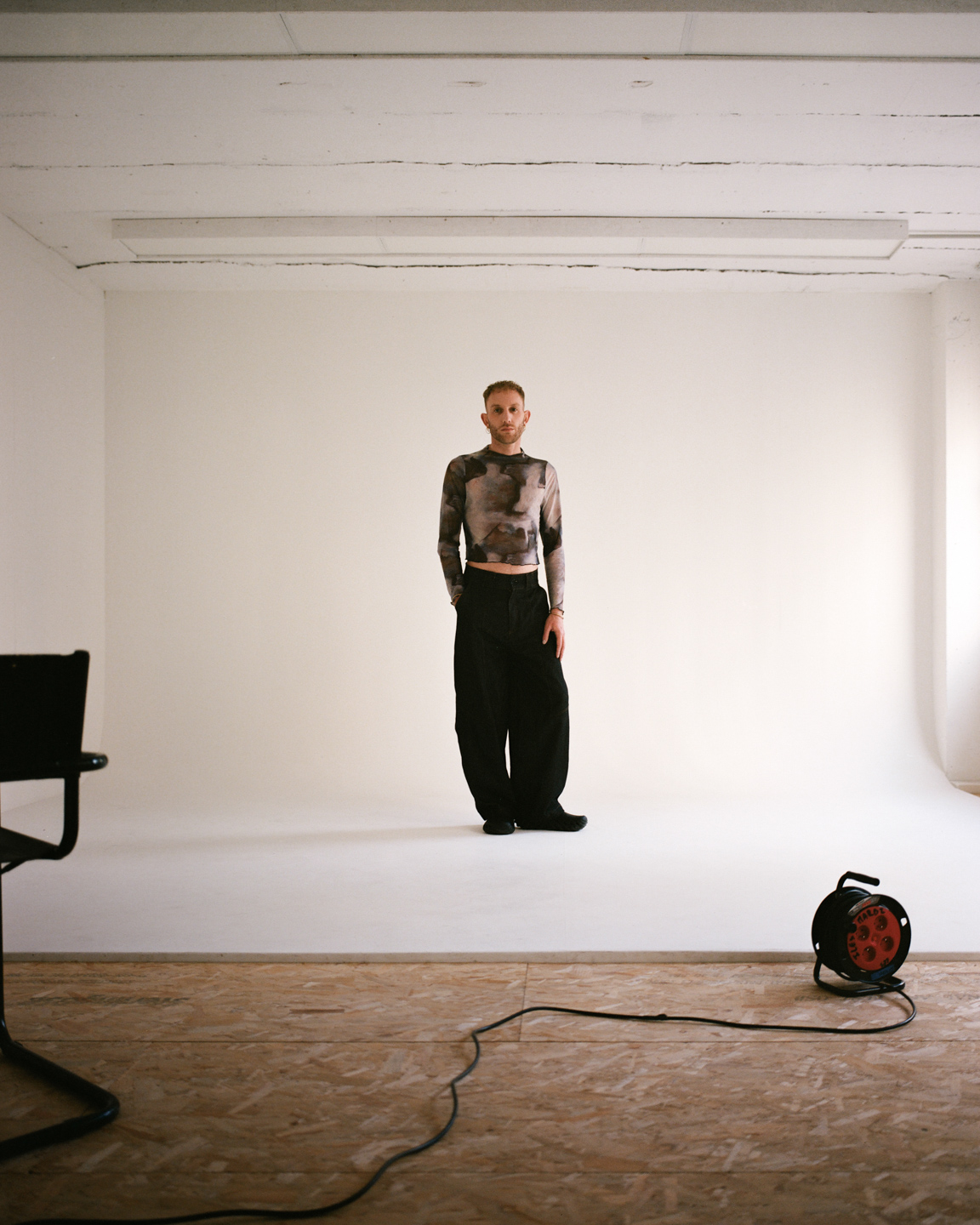
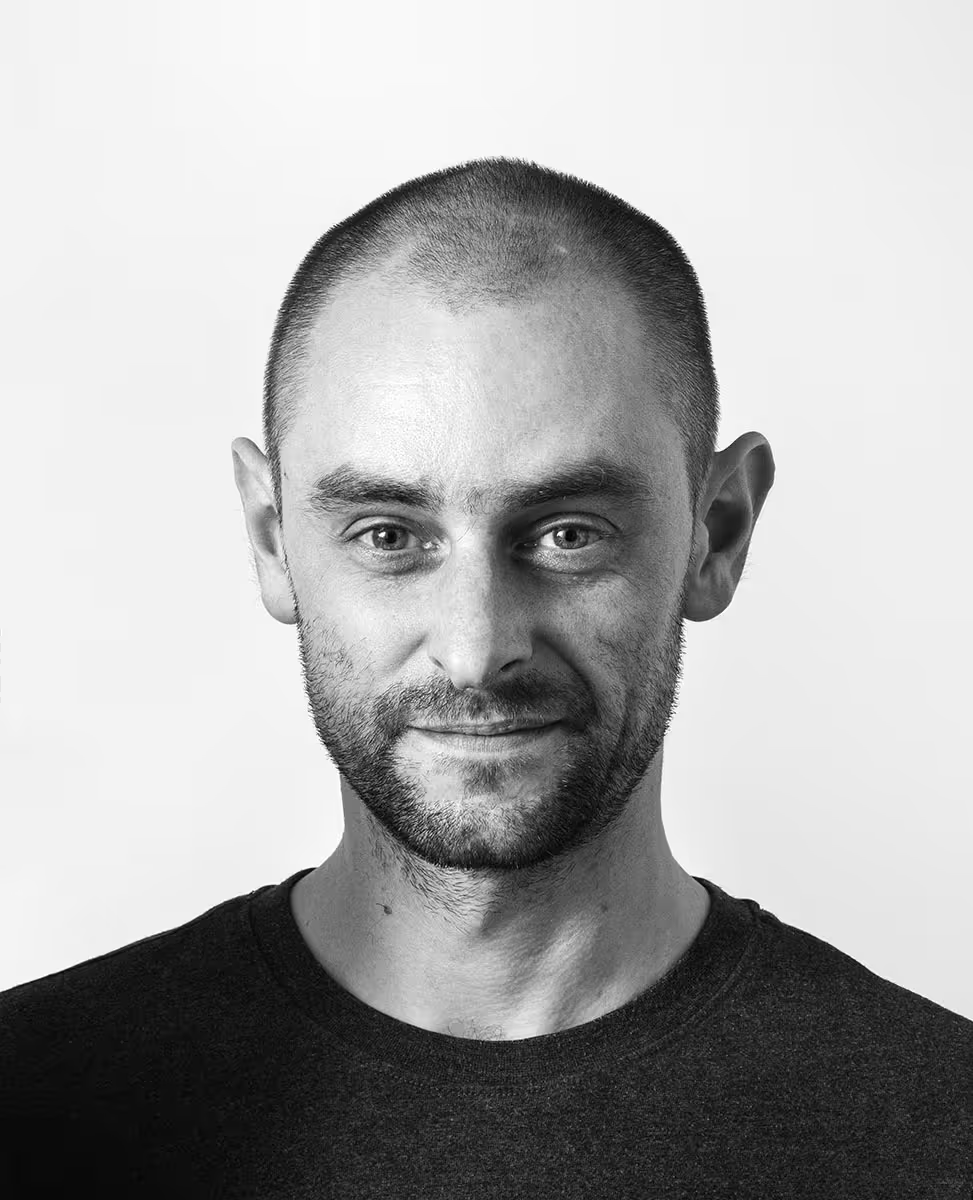
Michal Sita (1985) is a photographer and curator. Graduate of photography at the ITF in Opava and anthropology at the Adam Mickiewicz University in Poznań, where he is concluding doctoral research on social uses of the past in contemporary Poland. Interested in social memory and research strategies of photography. Curator of an interdisciplinary analysis of Wiesław Rakowski’s interwar zoological photographs, curator and producer of a series of exhibitions (including Małgorzata Lebda and Rafał Siderski, Mayumi Suzuki, Jan Kurek, Martin Parr and Rimaldas Vikšraitis, Sputnik Photos, among others), and photobook festivals. Co-author of “Củ Chi Tunnels Restoration Report” (Photographic Publication of the Year 2020 – Łódź, PL), a book relating to the activities of the Polish-Vietnamese architectural heritage conservation mission. Author of “History of Poland” vol. 1 and 2 — publications commenting on anthropological research carried out in Murowana Goślina among volunteers staging a large-scale historical pageant. Author of critical texts on photography. Lecturer at the Magdalena Abakanowicz University of Arts in Poznań.

Olena Morozova is a visual artist from Kyiv, Ukraine. She is interested in themes of spirituality, sexuality, gender identity, stereotypes, psychological and mental disorder, family relationships. "Photography is my passion, lifestyle, philosophy, way of thinking, seeing, understanding the world around me and my inner world, searching for my reflections, feelings and emotions, self-development and movement forward” - she explains. Olena has been engaged in photography since 2015. Her teachers were: Alexander Yakimchuk, Dimitri Bogachuk, Vladimir Seleznev, Viktoria Sorochinski, Sergey Melnichenko and others. Her works were presented in Finnish Museum of Photography (2022), Odesa Photo Days (2021), Photo Kiev Fair (2019, 2020).
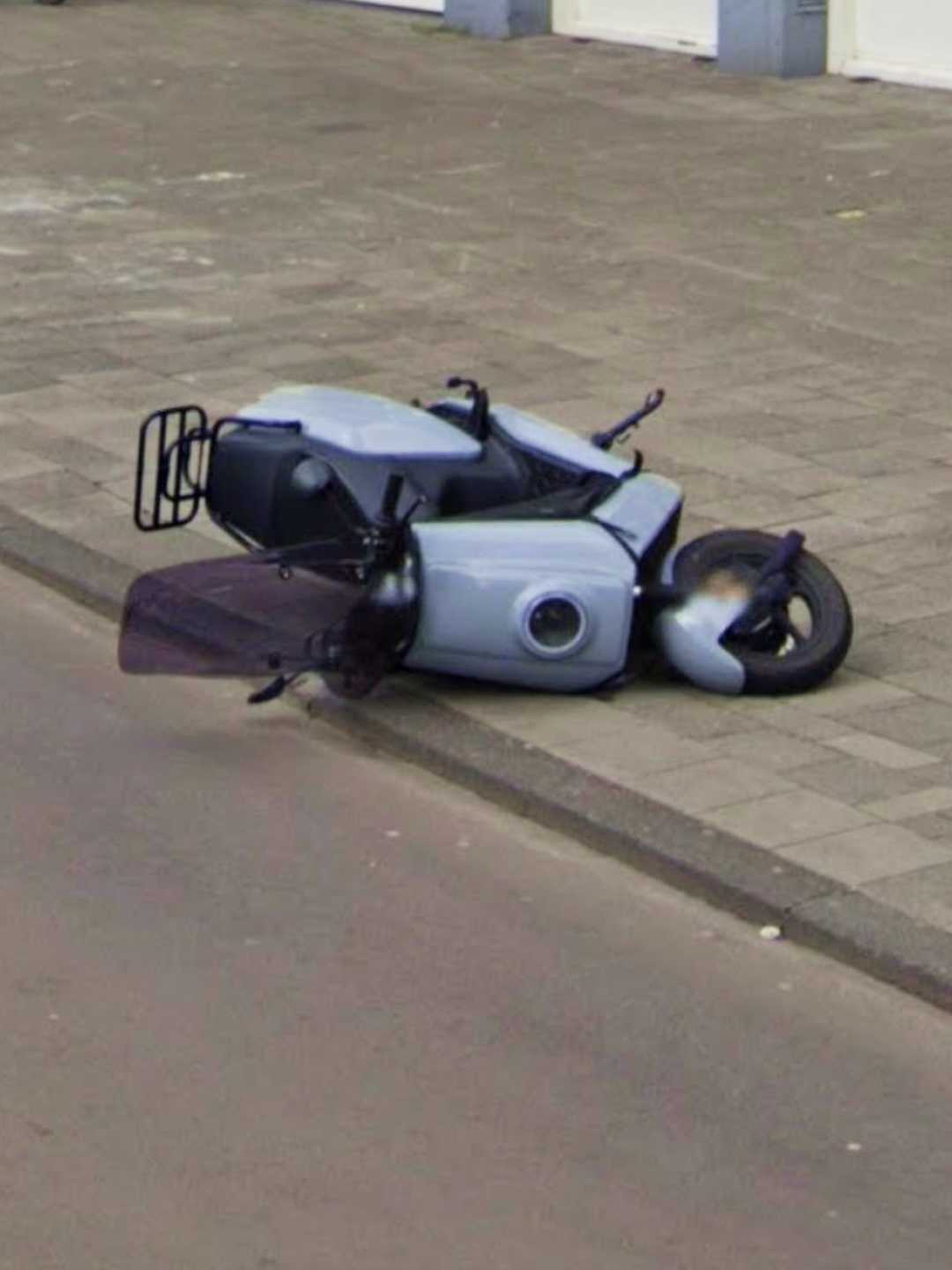
UNSTATED is a Zürich–based practice that merges the physical and digital worlds through innovative strategy and design.
We are committed to creating work that adapts to our changing environment.

Yu Shuk Pui Bobby (b. 1994) is a visual artist based between Hong Kong and Oslo. With a collaborative approach to her practice, her work conjures the physical, tangible and affective phenomena associated with biotechnology through combinations of video, text, installation, sculpture, and performance. She often uses speculative fiction to tackle questions of human genetic engineering, reconfiguring perceptions of gender, body and historical discourses of identity. Bobby holds a BA from Hong Kong Baptist University and an MFA from Oslo National Academy of Fine Art. Her works have been in Hong Kong, Norway, Japan, China, Iceland and the USA.

Laure Winants is a researcher and field-based visual artist (BE, FR). Winants set up her artist’s studio in the heart of the Arctic ice pack. Embarked on a four-month polar expedition, she joined a team of multidisciplinary researchers to understand the evolution of this vast territory, where man is only a tiny part of life. Immersed in this white desert, she uses techniques developed specifically to capture the optical and luminous phenomena unique to the region. Using environmental sensors, the interaction of matter itself has become the creator of the work, putting human intervention to one side. Laure Winants makes this data tangible and emotionally perceptible, highlighting the interdependence of ecosystems and creating encounters in more-than-human temporalities. In this way, the artist creates a dialogue between art, the natural sciences, and technology.
Laure has exhibited her work internationally in Berlin (DE), Reykjavik (IS), Brussels (BE), Paris (FR), and soon in Stockholm (SE), Luxembourg (LU), and Osaka (JP). Her work has entered the collection of several foundations, such as the Fondation des Arts du Luxembourg and the Palais de Liège (BE).
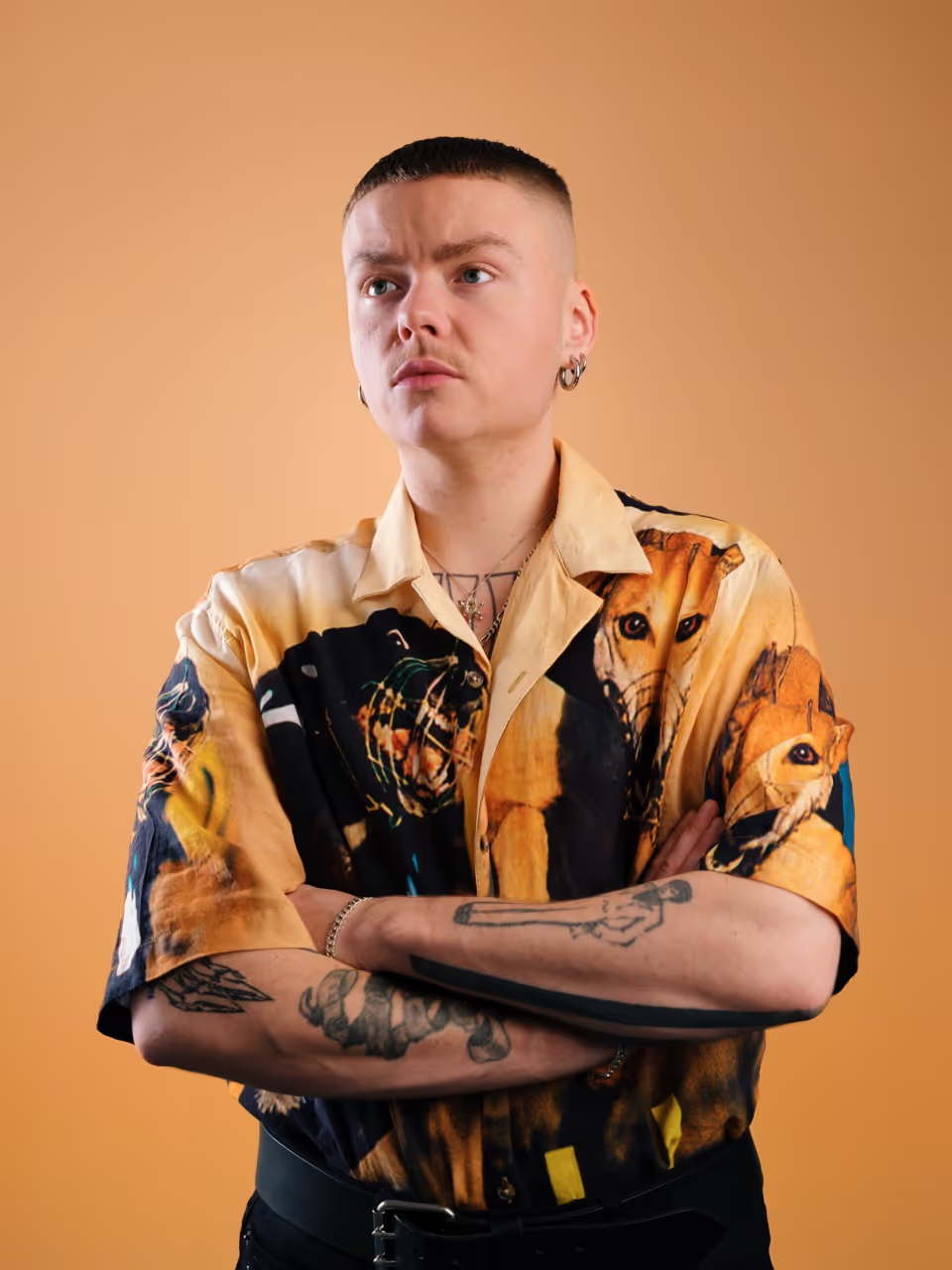
Julius Thissen (1993, the Netherlands) lives and works in Arnhem, NL. Their work investigates themes of community and representation, masculinity, sports, and competition. Originating from their background as a performance artist, Thissen's photographic practice aims to create narratives that explore the fine line between performing and failing. These themes are closely tied to contemporary performance-driven culture and the influence of societal expectations on behavior. Their work is deeply rooted in personal experiences as a genderqueer and transmasculine individual. Thissen strongly opposes the restrictive and often binary narratives imposed on transgender and queer individuals.
Thissen has been nominated for the Hendrik Valk Prize, Arnhemse Nieuwe, and the Warsteiner Blooom Awards. In 2023, they received the Artist Basis Fund and, more recently, a Mondriaan Fund Artist Project Grant for their new project Bones of Graphene, Skin of Kevlar.

Tim Rod is a Swiss artist based in Bern, Switzerland. He studied art education at HKB – Bern University of Applied Sciences (BA, 2018), art history at Bern University (Minor, 2019), photography at Vevey School of Photography (CEPV, ES diploma, 2021) and is currently pursuing a master’s degree in Contemporary Arts Practice at HKB – Bern University of Applied Sciences. His work often explores issues related to exile and habitat, rootlessness and rootedness, as well as memory, identity, belonging and travelling. His own roots and family history are one of the central elements of his practice and his research, alongside collective visual culture. While his practice remains strongly rooted in photography, his works often expand into site-specific multimedia installations. His work has been exhibited since 2018 in Switzerland and internationally since 2021. Recent exhibitions include "L’Été sans fin" (Festival Images, Vevey, 2020), "Genesis" (Hackney Downs Studios, London, 2021), Charta Bookfestival (Rome, 2021), Photobook Award Encontros Da Imagem (Braga, Portugal, 2021), and the European Photobook Month (Hongkong, 2022). He has been nominated or shortlisted to several major Swiss and international awards. His project "Don’t forget the Knifish" was awarded the special mention of the near.prize 2021. The same year, he won the vfg Young Talent Award for Photography with the project "À demain inshallah".

Thana Faroq is a Yemeni photographer and educator based in the Netherlands. She works with photography, texts, sound, and the physicality of the image itself, as a way to respond to the changes that have been shaping and defining her life, and sense of belonging both in Yemen and the Netherlands. Thana's positioning as a photographer is informed by her reflections on her subject matter, tuning in to other people’s lived experiences with which she continually grows familiar. She also increasingly seeks her own story in the frame. Thana was a recipient of the 2018 inaugural Open Society Foundation Fellowship Grant and Exhibition and the 2019 Arab Documentary Fund supported by the Prince Claus Fund and Magnum Foundation and Zenith magazine reporting grant. In 2020, she published her first book, I don't Recognize Me in the Shadows The book was shortlisted for the Lucie Photobook Prize 2021, and it has also been listed as one of the Interesting Artist & Photographic Books for 2021 by the PhotoBook Journal. Thana received her BA in Government and International Relations from Clark University, and an MA in Photography and Society at The Royal Academy of Art, The Hague.

Yu Shuk Pui Bobby (b. 1994) is a visual artist based between Hong Kong and Oslo. With a collaborative approach to her practice, her work conjures the physical, tangible and affective phenomena associated with biotechnology through combinations of video, text, installation, sculpture, and performance. She often uses speculative fiction to tackle questions of human genetic engineering, reconfiguring perceptions of gender, body and historical discourses of identity. Bobby holds a BA from Hong Kong Baptist University and an MFA from Oslo National Academy of Fine Art. Her works have been in Hong Kong, Norway, Japan, China, Iceland and the USA.

Valeria Cherchi (b.1986) is an Italian photographer. She was born and raised in Sardinia, Italy. Her practice focuses on projects regarding social and cultural issues. Her research is driven by the need of exploring topics such as time, memories and history connected to her personal experience. She is interested in true and tangible character-driven stories, often told by combining photography and text. In 2018, Valeria was one the named in ‘British Journal of Photography’s Ones to Watch.

Mirielle Rohr (b. Berlin) is a visual artist and photographer based between Paris and Berlin. She graduated from ECAL’s Master in Photography (Lausanne) in 2025. Through analogue photography, ceramics, sculpture, and AI-generated imagery, she examines the aesthetics and emotional economies of digital culture, how bodies, desire, and identity are mediated, performed, and consumed. Her works often combines tactile processes with synthetic image-making to produce psychologically charged narratives.
Her work has been published in the British Journal of Photography, Der Greif, Schema Magazine, SLEEK, and Fisheye Magazine, among many more. She was a finalist for the Picto Fashion Photography Award (2024) and presented her work at Paris Photo (Carte Blanche Étudiante, 2025) last year. In March 2026 she will exhibit at PhotoVogue Festival, is shortlisted for Un/Fund & Residency.